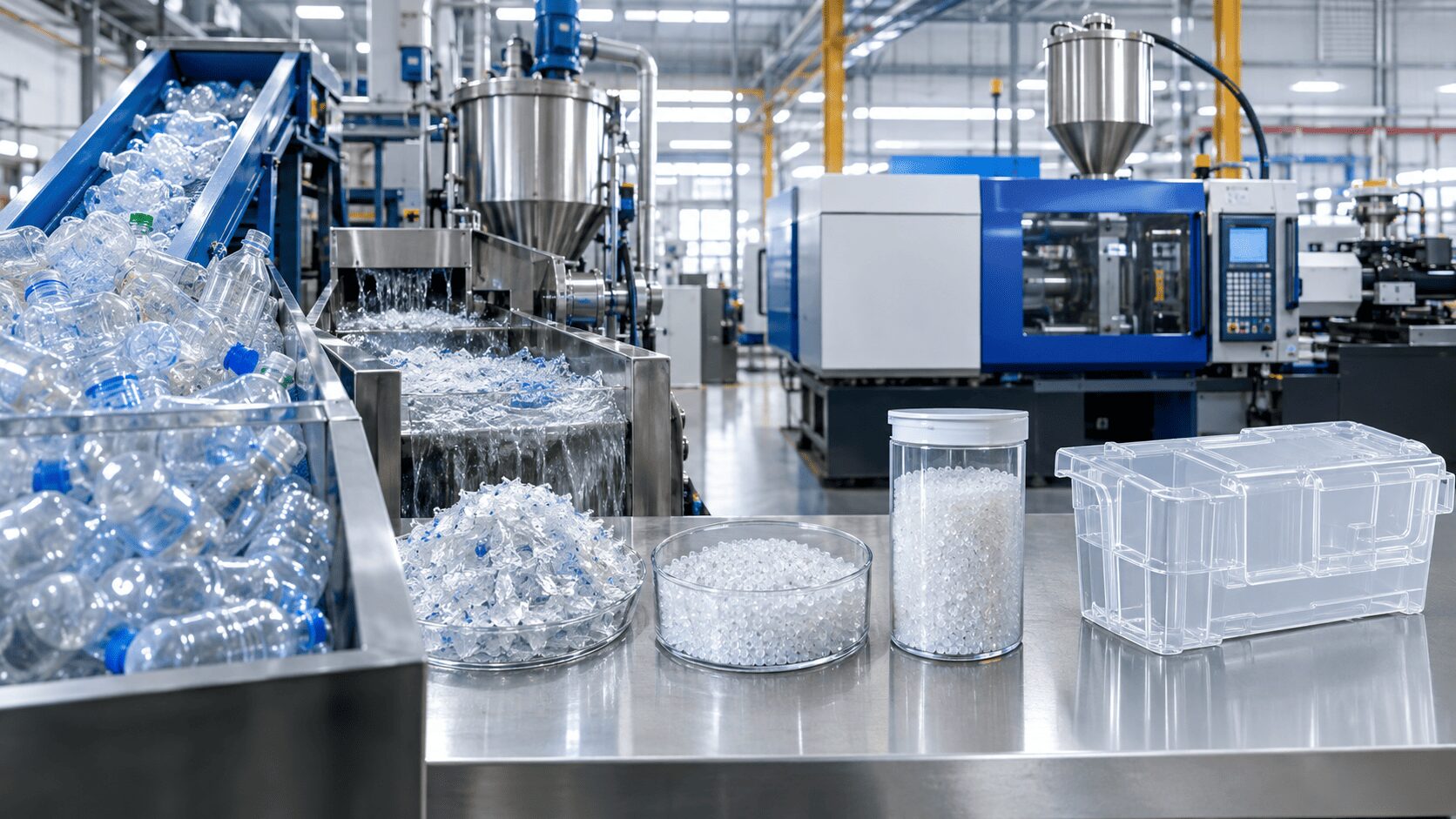
A post-consumer bottle is not automatically a production-ready engineering material. It must be collected, sorted, washed, processed, tested, and matched to the right application. That is where the benefits of recycled PET bottles become meaningful for manufacturers: not as a broad sustainability claim, but as a controlled material strategy that can reduce reliance on virgin resin while supporting defined product requirements.
For OEMs, product developers, and procurement teams, the practical question is not whether recycled content is desirable. It is whether recycled PET can meet the part’s mechanical, appearance, processing, regulatory, and supply requirements. The answer depends on the specification, the recycler’s process control, and the moulding partner’s ability to manage material variation.
Why Recycled PET Bottles Matter to Manufacturers
PET, or polyethylene terephthalate, is widely used for beverage bottles because it is lightweight, clear, strong, and recyclable. Once bottles enter a well-managed recycling stream, they can be converted into flakes or pellets for new bottles, sheets, fibers, packaging, and selected molded products.
Using recycled PET, commonly called rPET, gives manufacturers a route to incorporate recovered material into products that would otherwise depend entirely on virgin polymer. This can support internal environmental targets, customer material-content requirements, and broader efforts to reduce demand for new fossil-based feedstock.
The material benefit is especially relevant because PET bottles are collected at scale in many markets. A developed collection stream does not guarantee consistent resin, but it creates an available feedstock base that many specialty polymers do not have. For high-volume programs, that availability can make rPET a realistic part of a long-term sourcing plan rather than a limited demonstration project.
The Main Benefits of Recycled PET Bottles
Reduced demand for virgin resin
The most direct benefit is material displacement. Every verified percentage of recycled content used in an appropriate part reduces the amount of virgin PET required for that production run. For companies with annual material-use targets, this is measurable at the bill-of-material level.
The environmental impact varies by recycling method, transportation distance, energy mix, and the grade of virgin resin being replaced. It should not be presented as a fixed universal saving. Still, using established recycled feedstock can lower the material footprint of suitable products compared with using only virgin PET.
Stronger response to customer and market requirements
Recycled content has moved beyond marketing language in many B2B supply chains. Brand owners, retailers, industrial customers, and public-sector buyers increasingly request evidence of recycled material content and traceability. A product designed around qualified rPET can help an OEM respond to those requirements with a documented material decision rather than a late-stage substitution.
This matters particularly when a product is sold into multiple markets. Specifications may require supplier declarations, batch records, recycled-content certificates, or material test data. The manufacturing plan should anticipate those requirements before tooling is released, not after production begins.
Support for circular product design
Recycled PET bottles demonstrate the value of keeping usable polymer in circulation. The principle is simple: material recovered from one product stream becomes feedstock for another product or packaging format.
For manufacturers, circularity becomes practical when design choices support it. This may include reducing unnecessary material combinations, avoiding finishes that interfere with recycling, and identifying the intended end-of-life path at the beginning of product development. Recycled content is one useful lever, but it works best alongside parts designed for durability, repair, and material recovery.
Potential commercial advantages
Pricing for rPET does not always sit below virgin PET. Supply, demand from bottle-to-bottle recycling, color requirements, certification needs, and regional logistics all affect cost. However, qualified rPET can provide commercial value when it helps meet customer specifications, protects access to a program, or reduces exposure to a single virgin-resin sourcing strategy.
The objective should be total program value, not resin price alone. A lower-cost material is not a saving if it increases scrap, slows cycle times, creates cosmetic rejects, or requires repeated tool adjustments. A sound evaluation considers material cost, processing stability, rejection rate, testing, and supply continuity together.
What Changes When rPET Enters the Moulding Process
PET is sensitive to moisture during processing. If it is not dried correctly, hydrolysis can reduce molecular weight and compromise finished-part performance. Recycled PET adds another layer of control because incoming batches can vary in intrinsic viscosity, contamination level, color, particle distribution, and prior thermal history.
That does not make rPET unsuitable for injection molding. It means the process must be engineered around the actual grade. Drying conditions, melt temperature, residence time, screw design, back pressure, gate design, cooling, and regrind policy may all need review.
For precision components, material qualification should include more than a supplier data sheet. Production teams should run trials using the intended resin grade and target recycled-content level. Dimensional checks, visual standards, mechanical testing, and functional testing establish whether the part performs consistently under real production conditions.
At Glasfil, this type of evaluation aligns with an integrated manufacturing approach: design refinement, mould control, injection molding, secondary processing, and quality assurance must work as one production system. When tooling and molding teams can respond in-house, material-related adjustments can be assessed faster and controlled more directly.
Where Recycled PET Is a Good Fit
rPET can be a practical option for products where recycled content is valued and the material’s characteristics match the duty cycle. Suitable applications may include non-food packaging components, consumer product housings, storage products, trays, display components, furniture accessories, and certain construction-related parts.
Appearance expectations deserve early attention. Natural rPET may show a gray, yellow, blue, or variable tint depending on feedstock and processing. Black or darker colors can conceal variation more effectively, while highly transparent or premium white parts may require a tightly controlled grade, added colorants, or a different material strategy.
Part geometry also matters. Thick sections, highly polished surfaces, fine cosmetic textures, and tight tolerances can magnify inconsistency. In some cases, a virgin material or lower recycled-content blend is the better engineering decision. The responsible goal is not to maximize recycled percentage at any cost. It is to achieve a repeatable part that meets its intended performance.
Quality Control Is What Makes the Claim Credible
A recycled-content claim is only as dependable as the controls behind it. Manufacturers should define the rPET grade, target percentage, acceptable variation, color range, moisture specification, and required test results before serial production begins.
Incoming material verification should confirm that the supplied resin matches the approved grade. During molding, teams should monitor drying performance, process parameters, visual defects, dimensions, part weight, and functional characteristics. Batch traceability is equally important when customers require documentation or when a field issue must be investigated.
For safety-critical, electrical, food-contact, or highly regulated applications, the bar is higher. Regulatory suitability and migration, flammability, chemical resistance, impact performance, and long-term aging must be evaluated for the exact material and part configuration. A general statement that a resin contains recycled PET is not evidence that it meets a specific compliance requirement.
A Better Way to Specify Recycled Content
The most effective specification begins with part function. Define the load case, environment, service life, visual standard, dimensional tolerance, compliance needs, annual volume, and required recycled-content percentage. Then select candidate grades and validate them through molding trials.
Avoid writing a requirement such as “use recycled plastic wherever possible.” It creates uncertainty for sourcing and production. A more useful requirement identifies the polymer family, allowable recycled-content range, approved color range, test method, and documentation expected from the supplier.
It is also wise to build flexibility into the specification. If a 50% rPET grade delivers the necessary performance and stable production, requiring 100% recycled content may add cost or risk without improving the finished product. The right percentage is the highest level that can be supported by validated material supply and consistent manufacturing results.
Recycled PET bottles offer real value when recovery goals meet engineering discipline. For manufacturers, the opportunity is not simply to add recycled content to a product. It is to specify, test, tool, and produce a part that delivers on both its environmental commitment and its production requirements.
Ready to scale your next eco-friendly packaging line? Contact us today with your 3D models and target specs to get a validated production plan.