A molded housing that takes 12 seconds to assemble may look simple on a production drawing. But when it must be built thousands of times with the same fit, fastener torque, cosmetic condition, and traceability, assembly becomes a major manufacturing decision. Robotic versus manual part assembly is not a question of which method is more advanced. It is a question of which method gives your product the best combination of quality, speed, flexibility, and unit cost.
For OEMs and product developers, the right answer often depends on factors established well before production begins: part geometry, material behavior, annual demand, number of variants, and the way components are supplied. A practical assembly strategy considers the full process, from injection molding and secondary finishing through inspection, packing, and delivery.
Robotic Versus Manual Part Assembly Starts With the Part
Automation works best when the product is designed for repeatability. A robot needs consistent part presentation, stable dimensions, predictable pick points, and a reliable way to confirm that every operation has been completed. Injection-molded components are often well suited to this approach because tooling can control critical geometry at the source.
That does not mean every molded part should be handled by a robot. Parts with flexible features, highly reflective cosmetic surfaces, frequent design changes, or complex orientation requirements can introduce risk and cost. If a component arrives in a random bulk condition and must be carefully separated without marking its finish, the feeding system alone may become more complex than the assembly task itself.
Manual assembly is more tolerant of variation. An experienced operator can recognize a short shot, a warped feature, a missing insert, or an incorrect color before it moves downstream. That judgment is valuable during early production, when a product is still being refined, or when the assembly includes small batches with several configurations.
The key is to assess the complete product, not just one operation. A robot may insert a seal quickly, for example, but the business case changes if parts must be manually pre-oriented, inspected, and loaded into custom fixtures before the robot can begin.
Where Robotic Assembly Earns Its Place
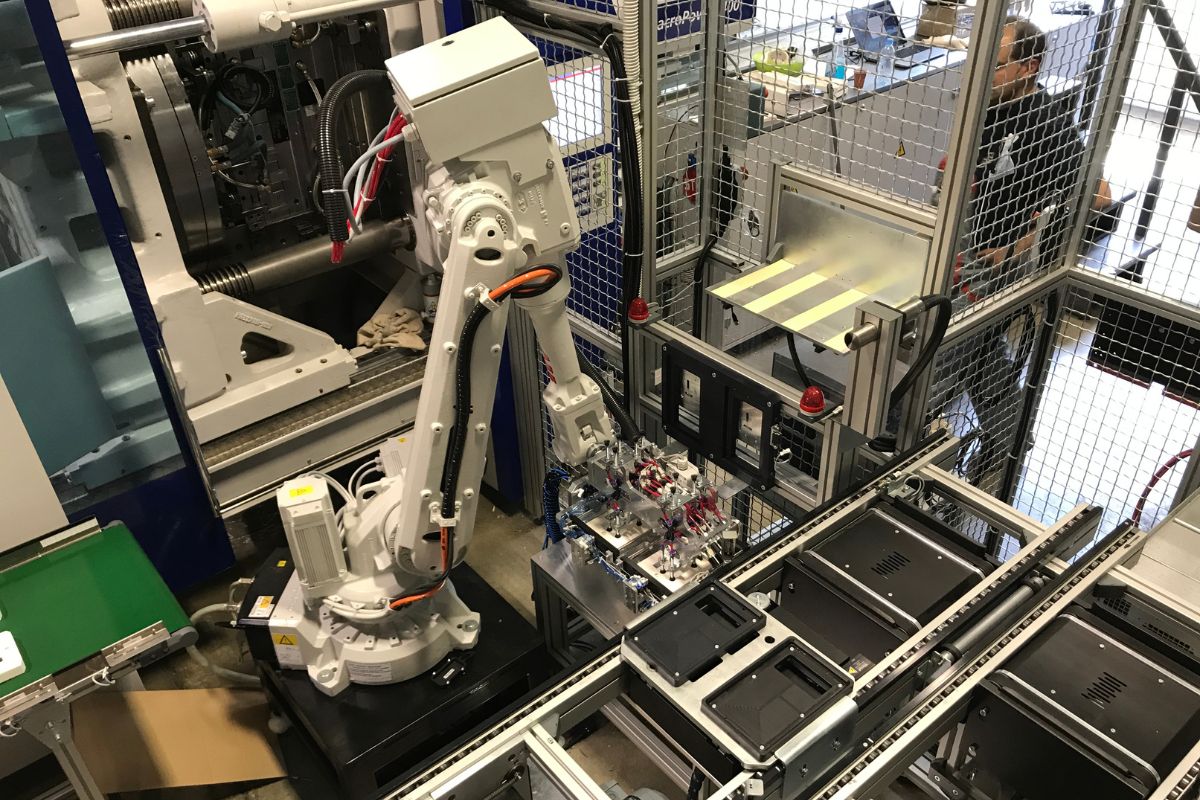
Robotic assembly becomes compelling when demand is stable and the work is repetitive. A properly engineered cell can perform the same motion, at the same position and force, throughout an extended production run. That consistency can reduce variation in tasks such as press fitting, ultrasonic welding, screwdriving, dispensing, labeling, and functional testing.
Repeatable quality at higher volumes
For high-volume components, the value of automation is not limited to cycle time. Robots can apply controlled insertion force, use vision systems to verify orientation, confirm component presence, and record process data for each unit. In industries such as automotive, electrical products, water metering, and automation equipment, that level of control supports traceability and helps contain quality issues before shipment.
A robotic cell also removes some sources of ergonomic and operator-to-operator variation. Repetitive pressing or fastening work can lead to inconsistent results over long shifts, even with well-trained teams. Automation keeps the process within defined parameters when the parts, fixtures, and inputs are stable.
Predictable throughput
When output requirements are known, a robot provides a more predictable baseline for capacity planning. Its cycle time does not depend on staffing fluctuations, breaks, or the time needed for a new operator to gain confidence with the task. This can be especially useful when assembly is directly connected to injection molding, where molded parts need to move quickly through finishing and packing without building unnecessary work-in-process inventory.
However, a robotic cell is only as productive as its slowest supporting step. Feeding, inspection, material replenishment, fixture loading, and changeover must be considered in the cycle-time calculation. A quoted robot cycle of eight seconds has little value if an operator needs 20 seconds to prepare the next set of components.
Better control over critical operations
Some assembly steps demand a level of process control that is difficult to sustain manually. A tight-tolerance press fit may require a specific force profile. A threaded insert may need controlled heat and depth. A safety-related component may require automated verification that a clip is fully seated. These are areas where automation can justify itself even at moderate volumes, particularly when the cost of a field failure is high.
Where Manual Assembly Remains the Better Option
Manual assembly is not a fallback for manufacturers without automation. It is often the most commercially sound process for low-to-medium volumes, high product mix, or assemblies still undergoing engineering changes.
Flexibility during launches and revisions
New products rarely remain unchanged after the first production run. A rib may be strengthened, a snap feature may be adjusted, a label position may move, or a customer may request an additional variant. Manual stations can generally accommodate these changes with revised work instructions and simple fixtures. A robotic cell may require new end-of-arm tooling, programming changes, vision updates, or modified feeders.
That flexibility matters when speed to market is the priority. For projects moving from concept to production on a tight schedule, it can be smarter to validate the assembly manually first. The process then generates real data about handling challenges, defect modes, and cycle times before capital is committed to automation.
Skilled visual and tactile judgment
People remain highly effective at handling complex assemblies with mixed materials, delicate surfaces, and variable component conditions. An operator can feel whether a gasket is properly seated, recognize whether a textured cover has been scratched, or adjust handling when a part has slight dimensional variation.
Manual processes can also support practical quality gates. A trained assembler who performs a task and inspects the result in the same station can stop suspect material early. The best manual operations do not rely on judgment alone. They use poka-yoke fixtures, clear visual standards, calibrated tools, and defined inspection criteria to make correct assembly easier than incorrect assembly.
Lower cost for variable demand
Automation requires an upfront investment in equipment, fixtures, programming, validation, maintenance, and spare parts. When annual volumes are limited or product demand is uncertain, those fixed costs can outweigh labor savings. Manual assembly converts more of the cost into a variable expense, which can be preferable for replacement parts, specialized industrial products, and multiple low-volume variants.
The Cost Model Should Include More Than Labor
A common mistake is to compare a robot’s hourly cost with an operator’s hourly wage. That comparison misses the cost drivers that determine whether an assembly method performs commercially.
For robotic assembly, include cell design, safety guarding, fixturing, end-of-arm tooling, part feeding, programming, commissioning, preventive maintenance, operator support, and expected downtime. Account for engineering time whenever the product changes. For manual assembly, include labor, training, supervision, ergonomic controls, inspection, rework, and the capacity needed to meet peak demand.
Quality cost deserves equal weight. A low-cost assembly method is not low cost if it produces intermittent leaks, loose fasteners, incorrect configurations, or cosmetic rejects. The most useful analysis measures the cost of a conforming finished unit, not simply the cost of putting two parts together.
A hybrid model is frequently the strongest option. Robots can handle repetitive, force-controlled, or safety-critical operations while trained operators manage inspection, special configurations, delicate finishing, and final packing. This approach can preserve flexibility without sacrificing control where it matters most.
Design for the Assembly Method You Need
Whether the process will be manual, robotic, or hybrid, assembly should influence part design early. Clear lead-ins, stable datum surfaces, accessible fastening points, positive locating features, and parts that can only fit in one orientation all reduce risk. For robotic handling, consider gripper access, gate location, part stiffness, and how components will be presented to the cell.
Mold design has a direct impact on assembly performance. Warpage, flash, inconsistent shrinkage, and poor gate placement can create downstream problems that no fixture or robot program can fully solve. Working with a manufacturing partner that controls tooling, molding, secondary operations, and quality inspection allows these issues to be addressed at their source. Glasfil applies this integrated view so that molded components are designed not only to meet dimensional requirements, but also to move efficiently through the operations that follow.
Before committing to a process, run a production-minded trial. Assemble representative parts, measure the true cycle time, track defects, test the fixture concept, and identify where variation enters the workflow. The result is usually clearer than an assumption based on volume alone.
The best assembly method is the one that protects product quality while keeping production responsive to real demand. Start with the part, validate the process under realistic conditions, and choose automation only where its repeatability creates measurable value.
Contact us to discuss your project, request a quotation, or arrange a technical consultation. Our team will help you determine the most cost-effective and reliable way to manufacture your part.