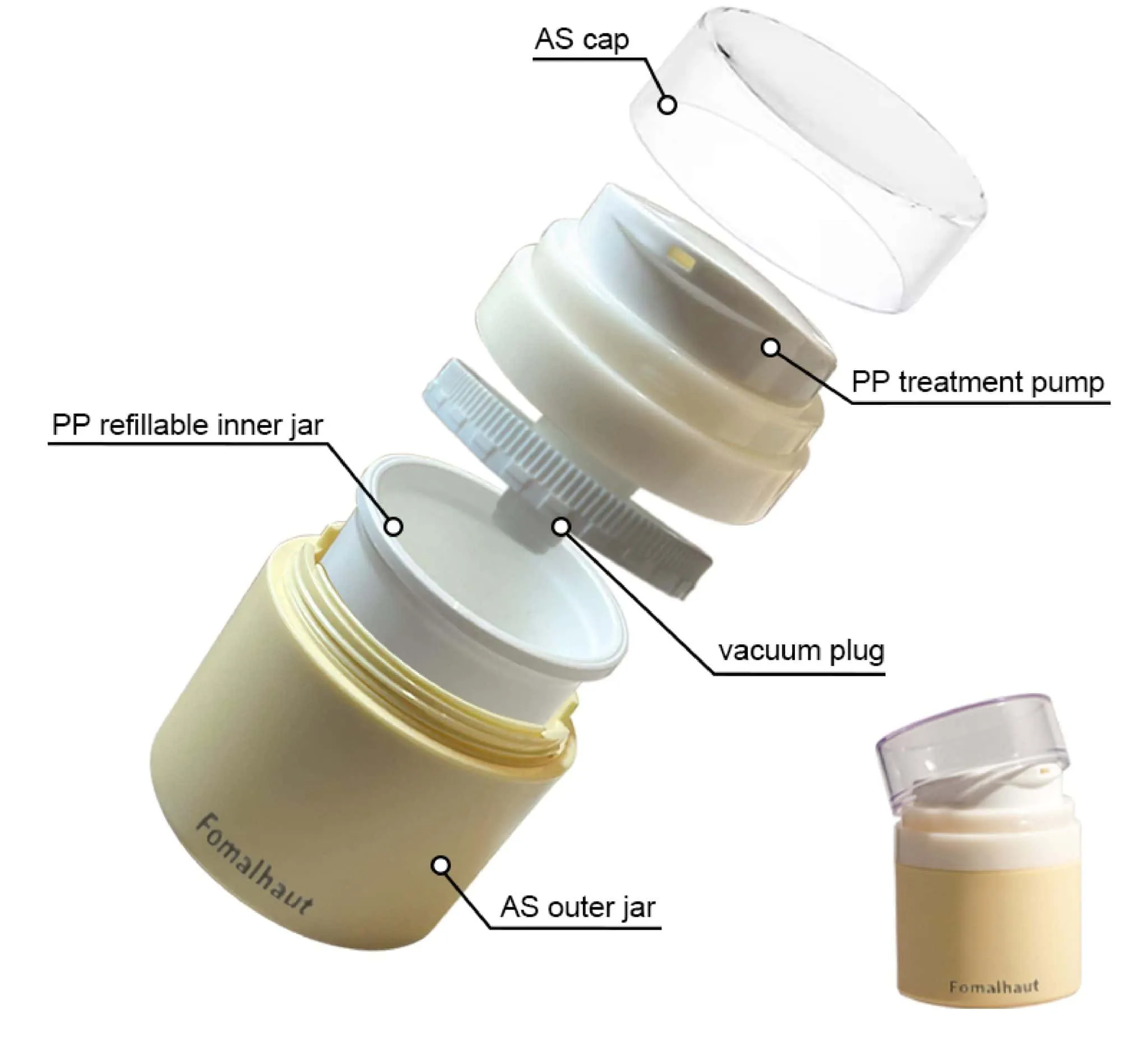
A refillable cosmetics pack can look simple on a concept board: retain the premium outer shell, replace the product-containing insert, and reduce material used per purchase. In production, refillable plastic cosmetics packaging design is a mechanical system with a consumer-facing promise. If the refill is difficult to release, leaks after repeated use, rattles inside the pack, or makes the brand look less premium, the concept fails regardless of its sustainability message.
For cosmetics brands, product developers, and procurement teams, the priority is not simply making a pack that can be opened. It is creating a package that survives filling, shipping, retail handling, daily use, repeated refills, and high-volume manufacturing without unnecessary complexity or scrap. That requires early decisions around architecture, material compatibility, tolerances, tooling, and assembly.
Why Refillable Packs Fail in Production
The most common mistake is treating a refill as an added component rather than designing the complete package around the refill cycle. A conventional single-use jar, compact, stick, or dispenser may rely on permanent snap features, adhesive labels, welded sections, or decorative parts that do not need to be removed. Once refillability is introduced, every one of those decisions needs to be reconsidered.
The outer pack must protect the refill and communicate value over multiple purchase cycles. The refill must be intuitive to install, secure during use, and economical enough to support the intended price point. The interface between them must accommodate normal injection molding variation without creating excessive insertion force, visible gaps, noise, or accidental release.
Design teams also need to distinguish between a refillable pack and a reusable-looking pack. A container with a removable cap is not necessarily refillable in a practical or hygienic sense. For products such as creams, serums, deodorants, powders, and color cosmetics, the refill process must protect product quality, avoid consumer confusion, and match the way the formula is filled and sealed.
Start Refillable Plastic Cosmetics Packaging Design With Architecture
The right package architecture depends on the formula, desired refill format, brand position, and expected purchase behavior. A premium facial cream may use a durable outer jar with a replaceable inner cup. A compact may retain its decorated housing while accepting a pressed-powder pan or molded refill tray. A skincare pump may use a replaceable bottle, pouch, or cartridge while preserving the actuator and decorative overcap.
The central question is simple: what should the consumer keep, and what should they replace? The answer should be based on function rather than appearance alone.
Separate the Durable Shell From the Consumable Component
The durable component typically carries the features that justify a longer life: decoration, mirror, closure mechanism, actuator, weight-enhancing elements, or a high-quality tactile finish. It needs enough structural strength to tolerate repeated assembly and disassembly.
The consumable component should contain only what is necessary to hold, protect, and dispense the formula. Reducing its part count can lower material use and assembly time, but it cannot compromise filling performance or leak resistance. For a jar system, that may mean a molded refill cup with a sealing lid. For a dispenser, it may mean a cartridge designed to connect reliably with the pump system.
This division also affects cost. A more substantial outer shell can be justified when it remains in use across multiple refills. However, adding too many decorative layers, metal inserts, or complex mechanisms can make the pack harder to manufacture, assemble, and recover at end of life. The most effective designs apply premium detail where it will remain with the consumer and simplify the component that is routinely replaced.
Design the Consumer Interaction Before the Tool
Refill insertion and removal should be obvious without written instructions. Consumers should know where to press, pull, twist, or lift. They should receive clear tactile or audible confirmation that the refill is seated correctly, but that feedback cannot come from a snap feature so aggressive that it damages the refill during removal.
Retention methods include snap fits, bayonet connections, threads, magnetic elements, and guided slide-in geometries. Each has trade-offs. Snap fits are fast and cost-effective but demand careful control of material flexibility and wall thickness. Threads can provide a strong, familiar connection but add cycle time and may collect product residue. Magnets create an elegant user experience but add purchased components, assembly steps, and material-separation considerations.
Guiding features are often as important as the primary lock. Lead-ins, locating ribs, keying geometry, and anti-rotation features prevent a refill from being inserted at the wrong angle or sitting proud of the outer shell. A package should not rely on the consumer forcing parts into place.
Material Selection Must Follow Formula and Function
Cosmetics packaging materials are selected for more than visual appearance. The resin must withstand the formula, the environment, the required hinge or snap performance, and the intended finish. Polypropylene is commonly useful for refill cups, caps, and living hinges because of its chemical resistance and fatigue performance. PET can offer clarity for certain bottles and jars. ABS, SAN, and acrylic-type materials may be considered for rigid, high-clarity, or premium-looking outer components, subject to application requirements.
Material choice becomes more demanding when the product contains oils, alcohol, fragrance, active ingredients, or volatile compounds. Compatibility testing should assess not only the container body but also stress points, sealing surfaces, decorative coatings, and any assembled parts exposed to the formula. A resin that performs well in a static sample may behave differently after months of contact under elevated temperature or repeated consumer handling.
Recycled content can support a brand’s material strategy, but it should be introduced with realistic performance expectations. Depending on the polymer and source stream, recycled resin can affect color consistency, flow behavior, surface appearance, odor, and mechanical properties. For highly cosmetic outer shells, virgin resin or a carefully controlled recycled-content formulation may be necessary to meet visual standards. For concealed refill components, the design may allow greater flexibility.
Tooling Determines Whether the Refill System Repeats Reliably
A refillable package depends on repeatable interfaces. That makes mold design and process control central to the project. Small changes in shrinkage, gate location, cooling balance, or warpage can alter the fit between the refill and shell. A nominally correct CAD model is not enough when two separately molded components must assemble smoothly across thousands or millions of cycles.
Critical dimensions should be identified before tooling begins. These usually include the refill retention bead, snap arms, thread profiles, sealing lands, alignment ribs, and cosmetic gap surfaces. Tolerance strategy should account for material shrinkage, mold wear, expected production variation, and the stacking effect of multiple parts. Over-specifying every dimension raises cost without improving function. Under-specifying the connection points creates assembly problems that surface after launch.
Tooling should also be designed for practical maintenance. Refillable packaging often includes fine engagement features that receive repeated mechanical stress. Inserts that can be serviced or replaced efficiently may reduce downtime when adjustments are needed. Full in-house mold modification capability is particularly valuable during development because fit issues can be corrected quickly without transferring tools between suppliers.
At Glasfil, product realization can be managed from mold design and fabrication through injection molding, finishing, packing, and shipping. That integrated control is useful for refill projects because the teams responsible for tooling, molded-part quality, secondary processing, and final assembly can address interface issues as one production problem rather than as separate supplier handoffs.
Validate the Full Refill Cycle, Not Just the First Assembly
A refillable design should be tested as consumers will actually use it. First-assembly testing is only the beginning. The system needs repeated insertion and removal trials, drop tests, transport evaluation, temperature exposure, closure-cycle testing, and, where applicable, product-contact testing.
Pay close attention to the failure modes that consumers notice immediately: a refill that lifts with the lid, a cartridge that rocks in its housing, a cap that no longer closes after several cycles, a visible mismatch between parts, or a part that requires excessive force. These issues may appear minor in engineering terms, but they directly affect perceived quality and refill adoption.
Assembly design also deserves early validation. If the outer shell requires a mirror, metalized insert, label, overcap, or decorative sleeve, determine how each operation affects the refill interface. Finishing applied after moulding can alter dimensions or create surfaces vulnerable to scratching during assembly. Packing must protect premium outer components while keeping refill units organized and free from deformation.
Build for Scale Without Overengineering
The best refill system is not always the one with the most advanced mechanism. A straightforward design with controlled snap geometry, well-defined locators, and compatible materials can outperform a complicated multi-part package that is expensive to assemble and difficult to maintain.
Early engineering should balance consumer experience against molding cycle time, part count, automation potential, quality inspection needs, and logistics. A design that looks excellent in a low-volume prototype may require refinement before it can run efficiently in repeat production. That refinement is where experienced tooling and molding input has the greatest value.
A refillable package earns repeat purchases when the replacement feels as considered as the original product. Treat the refill interface as a critical product feature from the first CAD review, and the final pack will be easier to use, easier to manufacture, and far more credible in the hands of the customer.
Contact us to discuss your project, request a quotation, or arrange a technical consultation. Our team will help you determine the most cost-effective and reliable way to manufacture your part.