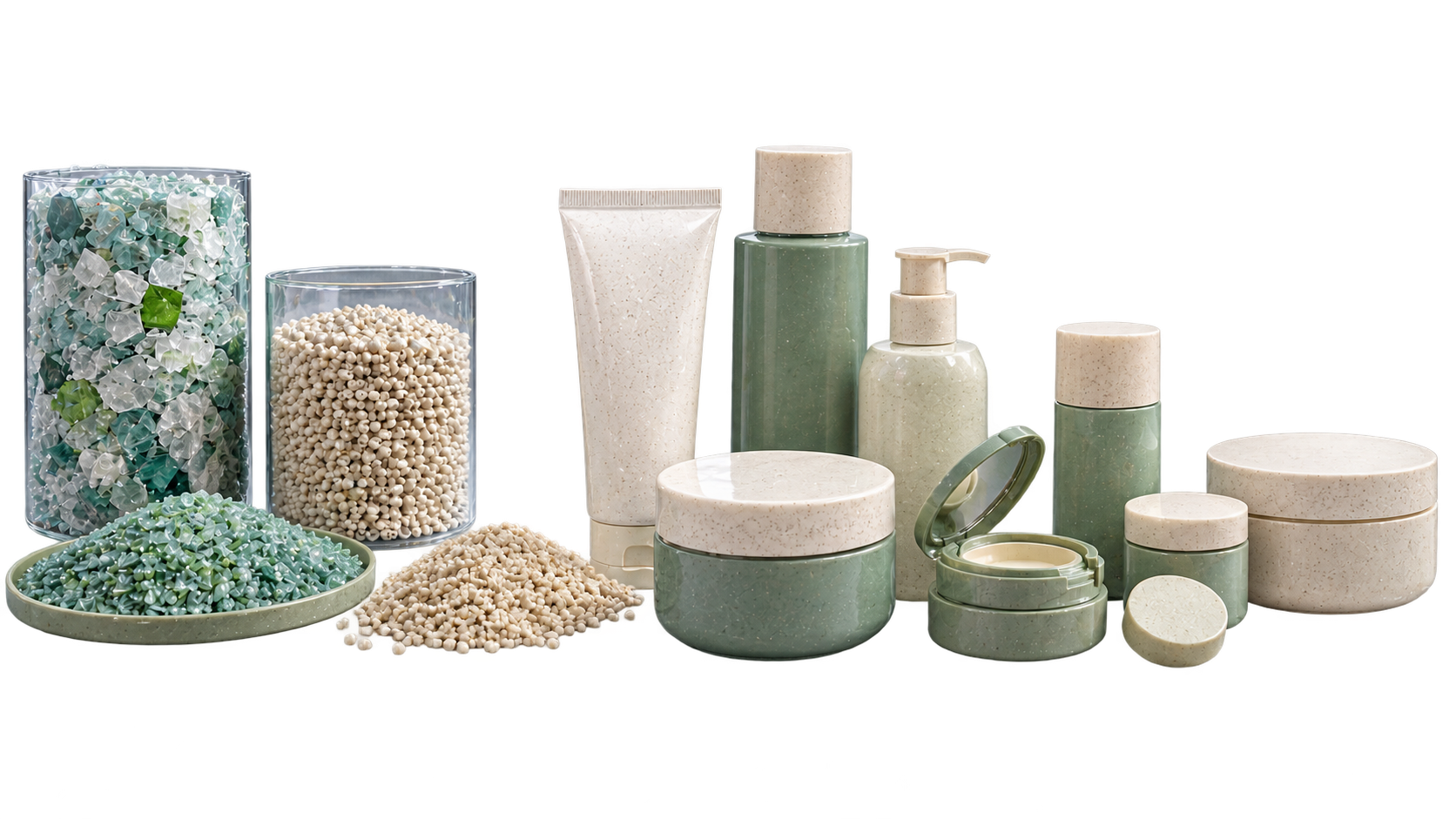
A recycled-content beauty pack can look excellent in a concept presentation and still fail at the production line. Color variation, flow marks, inconsistent wall thickness, fragrance interaction, and decoration defects can all turn a sustainability goal into a costly launch delay. Moving from plastic waste to beauty packaging requires more than selecting recycled resin. It requires engineering the package, tooling, process, and quality plan as one system.
For beauty brands, the opportunity is clear. Consumers increasingly expect lower-impact packaging, while retailers and brand owners are setting recycled-content and recyclability targets. The manufacturing challenge is to meet those expectations without compromising the tactile quality, visual consistency, dispensing performance, or shelf life that premium personal care products demand.
From Plastic Waste to Beauty Packaging Starts With Material Reality
Post-consumer recycled plastic, commonly called PCR, is made from material recovered after use, sorted, processed, and converted into usable resin. For rigid beauty components, recycled polypropylene and recycled PET are frequent options, depending on the application. Each material brings different opportunities and constraints.
PCR resin is not identical to virgin resin. Its previous life, collection stream, sorting quality, color, melt flow behavior, and contamination controls all influence how it performs during injection molding. A resin with higher recycled content may show greater color variation or require adjustments to drying, barrel temperatures, injection speed, holding pressure, and cooling time.
That does not make PCR unsuitable for demanding packaging. It means material selection must be based on the specific component rather than a generic recycled-content target. A thick-wall jar, a slim cap, a compact case, and a closure with fine threads do not place the same demands on resin or tooling.
For example, a dark or opaque cap can often accommodate a higher PCR percentage more easily than a clear, highly polished container. A natural, speckled appearance may reinforce a recycled-material story for one brand, while another needs controlled pigmentation and a refined surface finish. Both are possible, but the design and production route should reflect the intended result from the start.
Design for Recycled Content, Not Just Appearance
The most cost-effective time to solve manufacturing risk is before the mold is cut. Beauty packaging design often begins with visual intent, then adds sustainability requirements later. That sequence can create avoidable problems when a part was originally designed around virgin resin behavior.
A production-ready design considers wall thickness, ribs, snap fits, undercuts, gate location, draft angles, and the cosmetic surface at the same time. Uniform walls help resin flow and reduce the risk of sink marks, warpage, and uneven shrinkage. Proper draft supports clean ejection and protects visible surfaces. Gate placement matters because the point where resin enters the cavity can affect weld lines, flow patterns, and the final appearance of the part.
For a beauty component with a high-visibility exterior, the cosmetic surface should be protected in the mold design. Texture can be used strategically to reduce the visibility of minor resin variation, while polished surfaces may demand tighter material control. This is not a reason to avoid recycled materials. It is a reason to align the package architecture with the selected resin and the brand’s visual standards.
Material efficiency also matters. Reducing unnecessary weight lowers resin consumption and can improve cycle economics, but excessive lightweighting may create flexing, leakage, or assembly issues. The right balance depends on the product formula, closure system, transport conditions, and consumer handling.
Mono-Material Designs Improve the End-of-Life Story
A package can contain recycled content and still be difficult to recycle after use. Multi-material assemblies, metallic coatings, elastomer inserts, labels, springs, and mixed polymer components can complicate sorting and recovery.
Where product performance allows, mono-material design can improve the package’s end-of-life potential. A polypropylene jar with a polypropylene cap is generally simpler to manage than a package combining several incompatible materials. However, dispensing systems are a practical exception. Pumps, droppers, and airless mechanisms often require multiple materials to function reliably.
The goal is not to force a simplified design where it compromises dosage, hygiene, or user experience. The goal is to identify where material consolidation is realistic and where performance requirements justify complexity.
Tooling Determines Whether the Pack Can Scale
Beauty packaging is judged at close range. A small mismatch at a parting line, an inconsistent gloss level, or a loose closure can be immediately visible to consumers. Precision tooling is therefore central to producing recycled-content packaging consistently.
The mold must account for the selected material’s shrinkage and flow characteristics. It also needs appropriate venting so air can escape as the cavity fills. Poor venting can cause burn marks, incomplete filling, or surface defects. Cooling design is equally important because uneven cooling contributes to warpage and cycle-time instability.
For components with threads, hinges, living hinges, snap features, or tight assembly tolerances, mold precision directly affects functionality. A cap that looks correct but cross-threads on a bottle is not a finished solution. The same applies to jars that leak, compacts that do not close securely, or components that scratch during automated assembly.
An integrated manufacturer can move faster because design refinement, mold fabrication, mold modification, molding trials, and quality verification are handled under one production framework. At Glasfil, in-house mold modification capability supports this iterative process, allowing teams to adjust tooling based on trial data rather than waiting for an external tool shop to respond.
Validate the Formula, Finish, and Assembly Together
A beauty package is never just a plastic part. It is a system that must protect a formula, communicate a brand, and survive filling, packing, shipping, retail handling, and consumer use.
Compatibility testing should reflect the actual contents. Oils, alcohols, active ingredients, fragrances, and solvents can affect certain plastics or decorative finishes over time. Testing may evaluate stress cracking, discoloration, odor transfer, leakage, weight loss, and closure performance under relevant storage conditions. The required test plan depends on the formula and market requirements, but skipping this stage is a false economy.
Secondary finishing also deserves early attention. Hot stamping, screen printing, pad printing, metallization, coating, labeling, and laser marking may behave differently on PCR surfaces than on virgin material. Surface energy, texture, pigment loading, and molded-in variation can influence adhesion and visual uniformity.
The practical approach is to create production-representative samples before approving a finish. A perfect print on a laboratory plaque is not proof that the decoration will perform across a full molded production run. Qualification should include the actual resin grade, pigment, mold texture, decoration method, and expected handling conditions.
Quality Control Must Focus on What the Consumer Sees and Uses
Quality assurance for beauty packaging combines dimensional inspection with cosmetic review and functional testing. Dimensions confirm that parts assemble correctly. Visual standards confirm that color, gloss, texture, gate vestige, and surface quality remain within an agreed range. Functional checks confirm that the package closes, dispenses, and protects the product as intended.
With recycled resin, defining acceptable variation is especially valuable. Teams should agree on approved color limits, permissible flow marks, surface texture expectations, and sampling methods before mass production begins. This prevents subjective disputes after thousands of parts have been molded.
Traceability is equally useful. Recording resin batches, process settings, inspection results, and production dates helps isolate issues if they arise. It also gives procurement and product teams more confidence when scaling from pilot quantities to repeat orders.
The Commercial Decision Is About More Than PCR Percentage
Higher recycled content can support a stronger sustainability claim, but it may also affect resin availability, color control, processing consistency, and cost. The best specification is not automatically the one with the highest PCR percentage. It is the one that meets the brand’s environmental objective while protecting performance, appearance, supply continuity, and budget.
For some programs, a high-PCR opaque cap or jar is a practical first step. For others, a redesign around mono-material construction produces a more meaningful improvement. Premium products with crystal-clear visual requirements may need a different route than mass-market body care packaging. The answer depends on the component, the formula, the annual volume, and the acceptable level of visual variation.
The strongest next step is to review the package before tooling begins: define the recycled-content target, select candidate resins, identify cosmetic-critical surfaces, and test the formula and finish on production-representative parts. That early engineering discipline is what turns a sustainability intention into beauty packaging that can be made reliably, repeatedly, and at commercial scale.
Contact us to discuss your project, request a quotation, or arrange a technical consultation. Our team will help you determine the most cost-effective and reliable way to manufacture your part.