Precision Tooling: The Secret to Cost-Effective Lightweight Cosmetic Packaging
Lightweighting cosmetic packaging isn’t just about using less resin—it’s about optimizing production. Thinning a part’s wall without a precision mold often leads to costly sink marks, warped compacts, leaky closure seals, and cycle-time delays that wipe out your material savings.
For beauty brands and cosmetic product developers, lightweighting is a critical manufacturing decision. The mold must maintain luxurious visual standards, protect delicate formulations, and run reliably at high volume.
Designing Cosmetic Parts for Material Flow
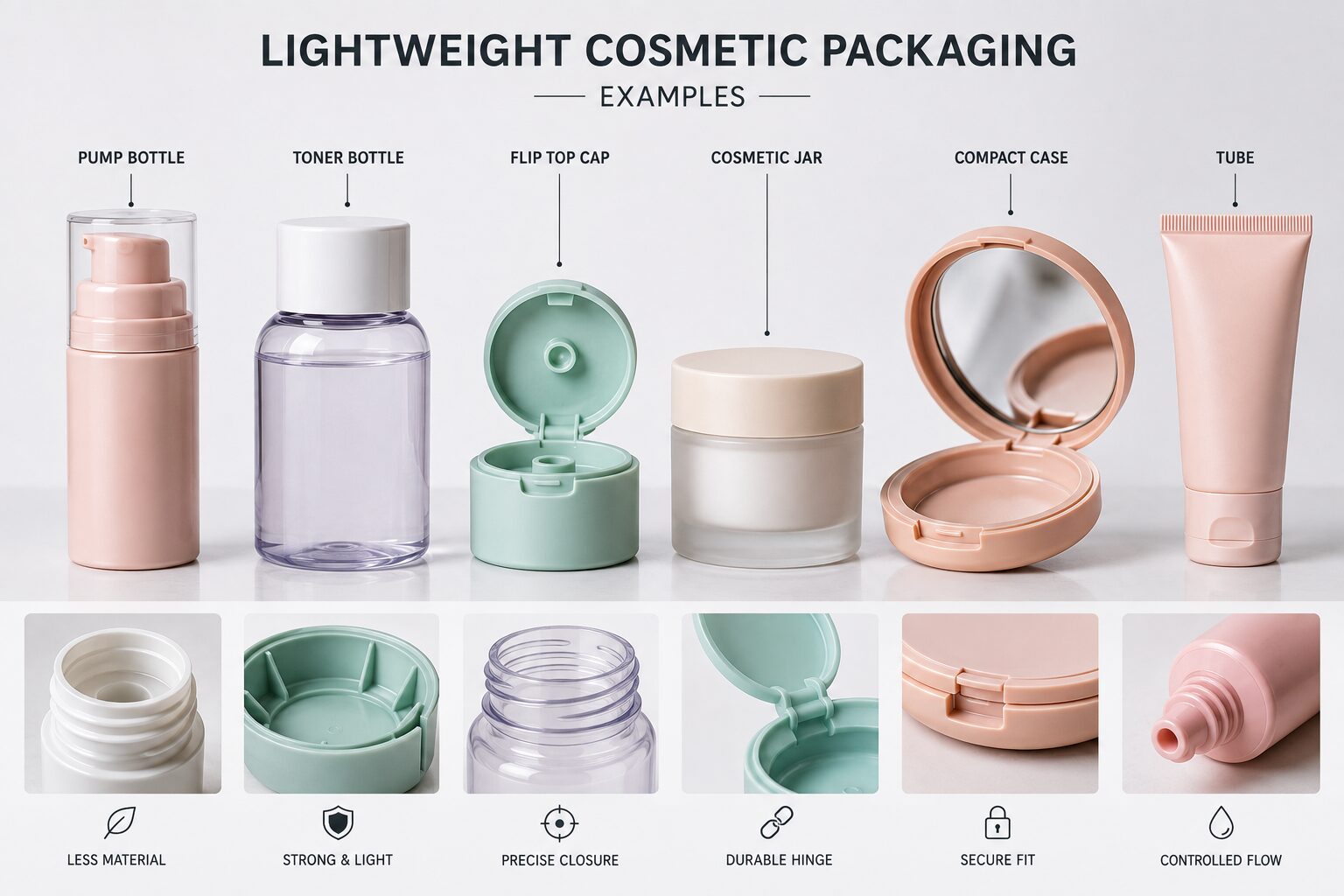
Removing material from critical functional areas—like cap threads, snap-fits, pump gates, or sealing lands—can cause structural failures during filling, shipping, or consumer use.
Thin walls increase melt flow resistance, risking short shots, weak weld lines, and surface flaws. Cosmetic lightweighting requires:
-
Gradual Thickness Transitions: Avoid sharp junctions to prevent flow lines.
-
Strategic Ribbing: Reinforce structural stiffness on jars or compact lids without risking sink marks.
-
Resin-Specific Tooling: Flow behavior varies dramatically whether you are molding with PET, Polypropylene, or Post-Consumer Recycled (PCR) resins.
Mould Design Essentials for Beauty Packaging
| Tooling System | Impact on Lightweight Cosmetic Packaging |
| Gate & Runner |
Hot runners minimize scrap and flow marks on high-end clear or decorated surfaces while ensuring multi-cavity fill balance. |
| Cooling Strategy |
Conformal and targeted cooling prevent part warpage and keep cycle times tight without compromising dimensional stability. |
| Precision Venting |
High-speed filling of thin-wall parts requires micro-venting to avoid gas burns and flow defects. |
| Gentle Ejection |
Flexible, thin-walled cosmetic parts require distributed ejection (e.g., stripper plates or air assist) to prevent scuffing and deformation. |
In-House Manufacturing Makes the Difference
A prototype only proves a concept; production tooling proves long-term profitability. At Glasfil, design, mold fabrication, injection molding, and quality control are managed entirely in-house. We evaluate engineering changes against live molding conditions to deliver stable, scalable, and premium cosmetic packaging—from initial trial to high-volume production.
Looking to lightweight your cosmetic line without sacrificing shelf appeal or structural integrity? Contact us today for a complete manufacturability and tooling review.