Moving an existing production tool is rarely a simple freight decision. A plastic mold transfer project in Malaysia can protect a proven product program, reduce supply risk, and bring production closer to a more responsive manufacturing partner. But the transfer only delivers those gains when project leaders assess the mold, molding process, quality requirements, and production responsibilities as one controlled operation.
For OEMs, product developers, and procurement teams, the question extends beyond whether a new facility can run a mold. The more useful question is whether the facility can produce the same approved part—consistently, at the required volume, and with a clear path for future repair or modification. That requires engineering ownership from the first tool inspection through stable repeat production.
Why companies transfer plastic molds to Malaysia
An operational problem often triggers a mold transfer: long lead times, inconsistent quality, limited communication with the incumbent supplier, or a need to consolidate tooling and part production under one manufacturer. A product redesign, a change in forecast volume, or the closure of a previous production source can also prompt a move.
Malaysia serves as a practical base for companies that need export-ready manufacturing backed by experienced technical support. For international programs, the benefit extends beyond geography. Teams gain the ability to combine tooling assessment, mold modification, injection molding, finishing, packing, and shipping within a single controlled production environment.
The strongest transfer projects build a better production system rather than just finding a new production location. When the receiving manufacturer maintains in-house tooling capability, engineers do not have to send process issues to a separate mold shop for diagnosis and repair. They can evaluate adjustments directly against actual molding results, reducing handoffs and eliminating lost time.
Start with the mold, not the shipment
Before arranging transport, engineers must establish the tool’s actual condition and technical compatibility. A mold may look complete yet carry hidden risks: worn shutoffs, damaged ejector pins, leaking cooling circuits, mismatched hot runner components, or undocumented settings essential to part quality.
A proper transfer review must confirm the mold size and weight, clamping force requirements, injection unit specifications, gate system, cooling connections, electrical needs, resin type, and expected cycle time. The receiving factory must also verify that its machines can run the tool safely and efficiently. For example, while a 560-ton press may accommodate a large mold, clamp tonnage alone does not confirm that the injection volume, tie-bar spacing, nozzle interface, and ejection stroke fit the application.
Tool documentation holds equal importance. Original 2D and 3D mold drawings, bills of materials, spare parts records, maintenance histories, molding parameters, approved samples, material specifications, and inspection reports provide a critical baseline. If a client lacks those records, the receiving engineering team must build a new technical record through direct inspection and trial production.
At this stage, an experienced manufacturer identifies whether a transfer truly makes sense. A tool with severe wear, an outdated design, or unsupported hot runner parts may cost more to stabilize than to rebuild. The final decision depends on part complexity, annual volume, product life cycle, and the financial impact of potential downtime.
Control the handover with a transfer plan
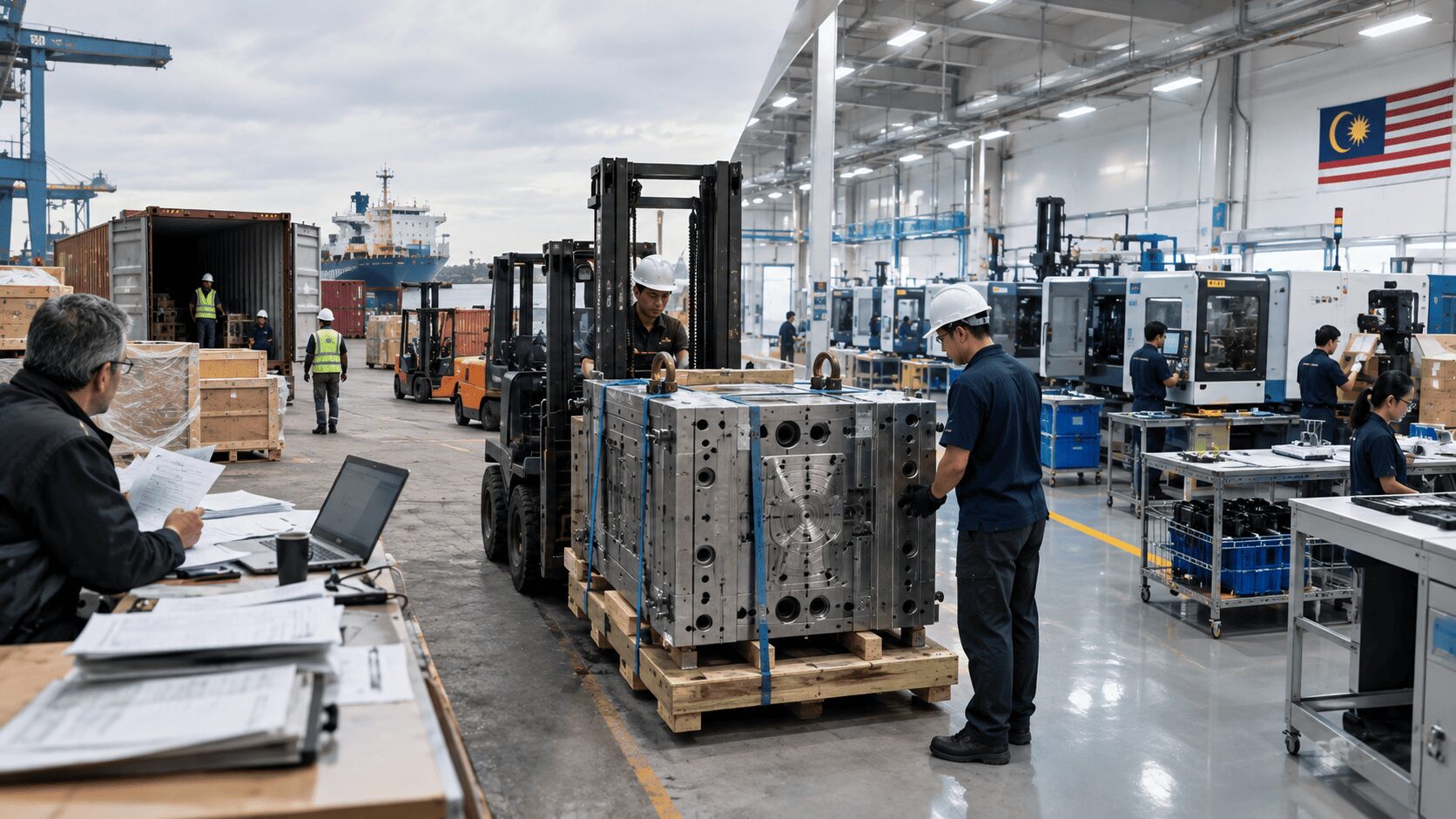
The physical relocation requires a documented plan rather than an informal pickup arrangement. Technicians must clean the mold, protect it against corrosion, secure it in suitable packaging, and clearly identify all components. Loose items, special connectors, spare inserts, and related fixtures should travel with the tool under an itemized packing list.
Project leaders must clarify ownership and responsibility before shipment. All parties should agree on tool ownership, insurance coverage, import documentation, tooling value declarations, and acceptance conditions at the receiving plant. These details become especially vital when a mold crosses international borders or when multiple vendors contributed to the tool’s original design and maintenance.
Upon arrival, technicians must check the mold against the transfer inventory before mounting it in a machine. This practice protects both the customer and the manufacturer by recording the tool’s exact condition at handover. Photographs, dimensional observations, and a documented assessment make it simple to separate pre-existing issues from new findings that emerge during the initial production trial.
Validate the process, not only the first sample
A part that looks acceptable on the first trial is not yet a qualified production part. Validation should confirm that dimensions, appearance, material performance, and assembly fit remain stable across a defined production run.
The initial setup begins with mold installation, safety checks, utility connections, and verification of the specified resin. The team then establishes a process window around key parameters such as melt temperature, mold temperature, injection speed, holding pressure, cooling time, and back pressure. The goal is not to copy a previous set of numbers blindly. Different machines, ambient conditions, material lots, and auxiliary equipment can change the way a mold behaves.
Quality review should compare trial parts with approved samples or agreed drawings. Critical-to-quality dimensions, weight, cosmetic requirements, color consistency, warpage, flash, sink marks, and short shots should be assessed according to the part’s application. Automotive, electrical, bathroom accessory, furniture, and utility components each carry different functional risks. A water meter component, for example, may require close control of sealing surfaces and dimensional interfaces, while a visible consumer component may place greater emphasis on finish and color.
Where required, the receiving manufacturer should produce a first article inspection report and retain approved reference samples. This creates a clear release point before volume production begins.
Use in-house modification capability to recover time
Mold transfers often expose problems that the prior supplier had been managing informally. A part may show recurring flash at a parting line, inconsistent fill in a thin section, poor cooling balance, or damage around a high-wear feature. These issues are not necessarily reasons to abandon the tool. They are reasons to assess corrective action quickly.
The speed of recovery depends heavily on who controls the tooling work. If mold repair, insert fabrication, polishing, welding, and fitting are managed in-house, the production team and toolmakers can work from the same trial evidence. They can test a correction, inspect the next sample, and make further adjustments without waiting for an outside vendor to interpret the problem.
At Glasfil, 100% in-house design and mold modification capability supports this type of control. The company operates 19 injection molding machines up to 560 tons across two manufacturing plants, allowing transferred tooling to be evaluated against the machine and process conditions required for production rather than treated as a standalone repair job.
Not every tool needs modification. In some cases, a well-maintained mold only needs cleaning, preventive maintenance, and process requalification. In others, a small insert change can remove a long-running defect. The correct level of intervention should be based on evidence from inspection and trials, not assumptions about the tool’s age.
Plan for repeat production from day one
A successful plastic mold transfer in Malaysia is measured after the first shipment, not after the first trial. Once production is approved, the manufacturer should establish preventive maintenance intervals, spare component requirements, approved process settings, inspection frequency, packing specifications, and traceability controls.
This is particularly valuable for discontinued parts, service parts, and programs with variable demand. If the mold is stored and maintained by the same partner producing the component, it can be prepared for repeat orders without the uncertainty of locating the tool, reviewing its condition, and rebuilding process knowledge each time.
For high-volume programs, production planning should also account for machine availability, material supply, secondary operations, and outbound logistics. An integrated manufacturer can coordinate molding with printing, assembly, finishing, packing, and shipment so that the customer receives a finished production-ready component rather than an incomplete manufacturing handoff.
Questions to ask before selecting a transfer partner
The right partner should be able to answer practical questions directly. Can the factory inspect and run the mold on equipment that matches the application? Can it repair or modify the tool without outsourcing critical work? How will it validate the transferred part? What quality records will be provided? How are preventive maintenance and stored tooling managed? Can the supplier support secondary processing and export packing when the program grows?
The answers reveal whether the supplier is prepared to take responsibility for the full production outcome. Price matters, but the lowest transfer quote can become costly when it excludes inspection, trial runs, repair capability, or formal validation.
A mold is a production asset, not a package to be relocated. Treating its transfer as an engineering and quality project gives OEMs a stronger foundation for dependable supply, faster corrective action, and repeatable plastic part production long after the tool reaches its new home.
Contact us to discuss your project, request a quotation, or arrange a technical consultation. Our team will help you determine the most cost-effective and reliable way to manufacture your part.