A family mold can reduce an initial tooling budget while putting several related parts into production at once. However, part count alone cannot answer when family tooling is truly economical. The real answer depends on production volume, cavity balance, material flow, quality requirements, and the cost of lost output when a single component changes.
For OEMs and product teams launching assemblies with multiple molded components, family tooling offers a commercially sound route to market. For other programs, it introduces hidden constraints that ultimately cost more than building a second tool. The goal is not merely building fewer molds, but selecting a tooling strategy that supports stable, repeatable, and profitable production.
What family tooling means in practice
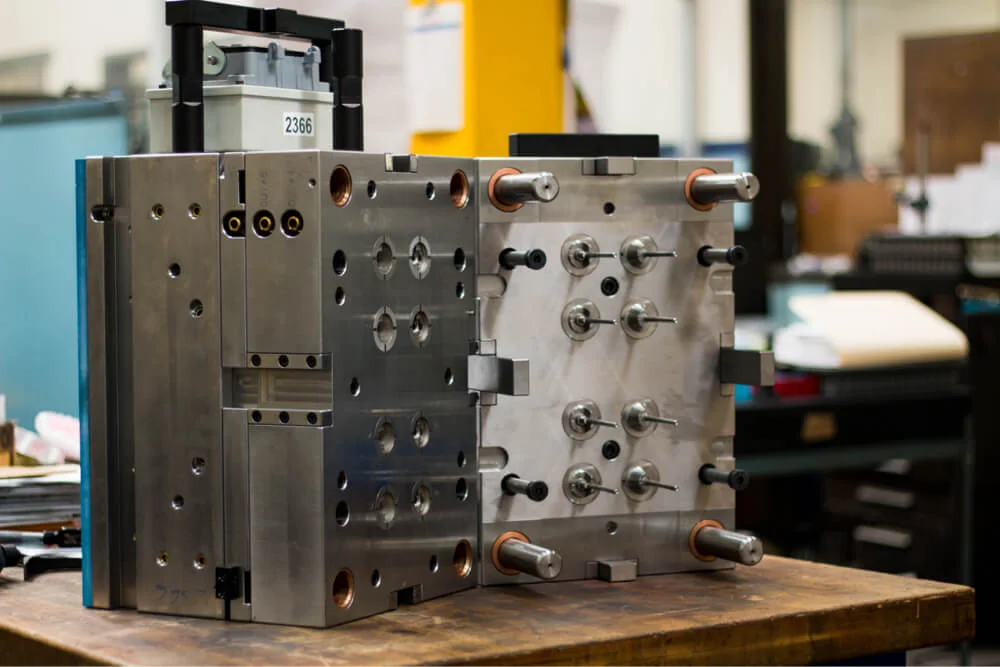
A family mold contains two or more different part geometries within the same tool base. Each cycle produces a complete set of components or a defined part mix—such as a bathroom accessory assembly, electrical enclosure, furniture fitting, or water meter set—provided the components use the same resin and run in matching quantities.
-
Multi-Cavity Mold: Every cavity produces the exact same component (e.g., four identical caps per cycle).
-
Family Mold: Produces a combination of different parts per cycle (e.g., one housing, one cover, and two smaller clips).
The appeal stems from using one mold base, one build process, and one molding setup, which lowers capital investment compared to buying several independent tools. It also simplifies early production planning when an assembly requires all parts simultaneously. However, these savings hold only when parts run together without compromising molding performance or operational flexibility.
When is family tooling economical for a product program?
Family tooling becomes economical when components share aligned demand, compatible molding conditions, and a stable design. These three factors carry more weight than theoretical savings on mold construction.
The strongest case involves low-to-medium volume programs where teams order and assemble multiple parts in a fixed ratio. If a product requires one front cover, one rear cover, and two retaining features per unit, a family mold produces that exact kit in a single cycle. Inventory stays balanced, purchasing simplifies, and capital goes toward one well-engineered tool.
Family tools also suit products using the same material grade and color. Combining a polypropylene housing and a glass-filled nylon bracket in one tool is unrealistic because their melt temperatures, shrink rates, mold temperatures, and processing windows differ. Even parts within the same polymer family behave differently if one grade is reinforced, flame-retardant, or formulated for a specific finish.
Finally, family tooling works well during product launches to validate demand without committing to multiple high-cavitation tools. Once demand scales, manufacturers can transition high-volume components into dedicated molds optimized for faster cycles.
The cost calculation must include output, not just tooling price
A lower mold quote does not automatically mean a lower part cost. The economic comparison should include the full production life of the product: tooling investment, cycle time, machine rate, material use, expected scrap, maintenance, downtime, and the cost of holding inventory.
A family tool may cost less than three separate molds, but it can occupy a molding machine for longer if the largest or thickest part dictates the cooling time. Smaller parts leave the tool fully cooled but still wait for the slowest cavity. Over tens of thousands of cycles, that additional machine time can erase the upfront tooling saving.
Demand imbalance is another common cost driver. Consider an assembly that needs one housing and four clips. If all features are represented once in a family mold, the production team will create too few clips. If the tool includes four clip cavities, flow balance and fill behavior become more complex. If the clips are later used in another product, their demand may exceed housing demand, forcing a separate tool anyway.
The calculation should also account for utilization. A dedicated mold can keep producing a fast-moving component while another tool is modified, maintained, or waiting for approval. With family tooling, every component shares the same production asset. That can be efficient when demand remains synchronized, but restrictive when product mix changes.
Part compatibility determines whether the mold will run consistently
Family mold design is an engineering exercise in balance. Different cavity sizes, wall thicknesses, flow lengths, gate locations, and part weights affect how molten plastic fills and packs each cavity. The tool must be designed so that all components fill correctly within a workable processing window.
Parts with similar projected area, wall thickness, and flow behavior are easier to combine. Components that require very different injection pressures or packing profiles are more difficult. A thin-wall clip may need rapid filling, while a thicker cover may require more packing time to control sink marks and dimensional stability. Trying to optimize both in one cycle can produce flash on one part, short shots on another, or inconsistent dimensions across the set.
Surface and quality requirements matter as well. A cosmetic exterior panel may require carefully controlled gate vestige, texture replication, and appearance standards. A hidden internal bracket may be more tolerant. Combining them is possible, but the tool and process must be engineered around the more demanding part. That increases complexity and may reduce the anticipated saving.
Mold flow analysis, gate selection, runner balancing, cooling design, and venting are therefore not optional steps. They are the controls that determine whether a family tool becomes a dependable production asset or a source of recurring quality issues.
Cold runner versus hot runner considerations
Runner design can change the economics significantly. A cold runner family tool may be appropriate for shorter runs and simpler part geometries, especially when the runner can be reground and returned to the process without affecting material performance.
For higher volumes, a hot runner system can reduce material waste and improve cycle efficiency. Yet it adds initial investment, maintenance requirements, and another technical variable when cavities differ substantially. The appropriate choice depends on annual resin consumption, material cost, cycle target, and the need for consistent gate quality.
Design changes can make one tool a production bottleneck
Family tooling functions best with mature part designs. When one part requires a revision, technicians must pull the entire mold from production for modification—halting output for every other unchanged component in that tool.
If early-stage product development involves ongoing changes to snap fits, mounting bosses, or cosmetic details, separate prototype or bridge tooling offers greater operational flexibility. Spending slightly more on independent tools prevents repeated disruptions to the primary manufacturing line. Integrated operations—such as Glasfil’s in-house mold design, repair, and injection molding—provide direct control over engineering changes, sampling, and corrective actions.
Situations where separate molds are the better investment
Dedicated tools represent the stronger choice when:
-
One component exhibits significantly higher demand than others.
-
Parts require different materials, additives, or colors.
-
The assembly geometry is expected to evolve over time.
-
High-volume parts require ultra-short cycle times and high-cavitation molds.
Separate molds limit business risk. Maintenance on one tool does not stop the entire assembly line, design revisions affect only the targeted component, and production schedules can adapt dynamically to actual market consumption.
A practical decision process before releasing tooling
Before approving a family mold, engineering and procurement teams should validate three main areas:
-
Resin & Demand Alignment: Confirm components share the exact resin specification, color strategy, and molding window. Compare annual demand against the output ratio produced per cycle.
-
Moldability Review: Evaluate wall thickness, flow length, projected area, shrinkage rates, cosmetic standards, and cooling requirements together.
-
Product Roadmap: Identify which features are likely to change, which parts may be sold separately as spares, and which component’s downtime would cause the greatest supply chain disruption.
Family tooling earns its place when it produces the correct parts in the right ratio, at a cycle time and quality level the business can sustain.
Contact us to discuss your project, request a quotation, or arrange a technical consultation. Our team will help you determine the most cost-effective and reliable way to manufacture your part.