A part can look simple on a drawing and still fail in production because the resin choice was wrong. When buyers ask for the best plastic for injection moulding, the right answer is rarely a single material. It depends on how the part will be loaded, what environment it will face, the finish required, the expected production volume, and how tightly the process must be controlled.
For OEMs, product developers, and procurement teams, material selection is not a catalog exercise. It affects tooling design, cycle time, dimensional stability, secondary operations, defect risk, and long-term cost. A lower-cost resin can become expensive if it warps, sinks, cracks, or slows down production. A higher-performance resin can be the better business decision if it reduces rejects and improves field reliability.
How to choose the best plastic for injection moulding
The first filter is function. A housing for an indoor consumer product has a very different requirement profile than an automotive clip, an electrical component, or a water-handling part. Strength, stiffness, impact resistance, chemical exposure, UV stability, flame performance, and temperature resistance all need to be defined before resin selection starts.
The second filter is manufacturability. Some plastics flow easily into thin walls and complex geometries. Others demand tighter processing windows, higher mold temperatures, or more careful gate and cooling design. If a resin performs well on paper but creates unstable production, the total project cost rises fast.
The third filter is economics across the full program. Resin price matters, but so do mold life, cycle time, scrap rate, finishing requirements, and consistency across repeat orders. In production, the best material is the one that balances part performance with stable, scalable output.
The most common candidates for the best plastic for injection moulding
Polypropylene (PP)
PP is often the starting point for cost-sensitive, high-volume parts. It offers good chemical resistance, low density, and strong fatigue performance, which makes it useful for caps, containers, living hinges, appliance components, and utility parts.
Its main advantage is value. It processes efficiently and can work well for parts that do not need high structural rigidity. The trade-off is that PP is not the best choice where tight tolerances, premium surface feel, or high heat resistance are critical. It can also show more shrinkage than some engineering plastics, which must be managed in tool design.
Acrylonitrile Butadiene Styrene (ABS)
ABS is widely used for housings, enclosures, and interior components because it combines decent toughness with a clean surface finish. If appearance matters, ABS is often a strong option. It machines and textures well, which helps when cosmetic quality is part of the specification.
The limitation is environmental exposure. Standard ABS is not ideal for prolonged UV conditions or aggressive chemical contact unless the grade is modified. For indoor products and controlled-use applications, it remains one of the most practical choices.
Polycarbonate (PC)
PC is selected when impact strength and transparency matter. It is common in protective covers, technical housings, and parts that need to retain toughness under stress. Compared with ABS, it offers stronger heat resistance and better impact performance.
That performance comes with processing demands. PC can require tighter drying control and careful molding conditions to avoid splay, internal stress, or optical defects. It is an engineering resin, not a forgiving commodity material.
PC/ABS blends
For many commercial and industrial products, PC/ABS blends offer a strong middle ground. They combine the toughness and heat resistance of polycarbonate with the processability and surface quality of ABS. This makes them useful for durable enclosures, automotive interior parts, and electrical housings.
When buyers need balanced performance without moving into more expensive high-spec materials, PC/ABS is often worth serious consideration. It is not always the cheapest route, but it can reduce compromise.
Nylon (PA)
Nylon is a strong candidate for mechanical parts that need wear resistance, strength, and thermal performance. Gears, clips, brackets, and under-the-hood components often use PA6 or PA66, sometimes with glass fiber reinforcement.
The caution with nylon is moisture absorption. That affects dimensions and mechanical behavior over time, so the application environment matters. Reinforced grades can deliver excellent structural performance, but they can also increase mold wear and require more disciplined process control.
Acetal (POM)
POM is valued for low friction, dimensional stability, and good fatigue resistance. It performs well in precision parts such as gears, bushings, valves, and snap-fit components. For moving parts or assemblies that require repeatable fit, acetal is often a better choice than lower-cost commodity resins.
Its strengths are clear, but part geometry and application details still matter. Designers need to account for shrink behavior and assembly stresses. With proper tooling and process setup, POM is one of the most dependable resins for precision functional parts.
Polyethylene (PE)
PE, especially HDPE and LDPE variants, is useful where chemical resistance, flexibility, and toughness are more important than rigidity. It is common in containers, covers, liners, and certain utility products.
For structural or high-precision parts, PE is usually not the leading option. But for the right application, it is economical and durable. As with PP, the best results depend on matching expectations to the material’s actual performance range.
When engineering plastics are the better choice
Some applications move beyond commodity resins quickly. Electrical parts exposed to heat, automotive components under load, or industrial housings needing dimensional control may require materials such as PBT, PPS, or high-performance filled nylons. These materials are more expensive, but they can solve problems that cheaper resins cannot.
This is where many projects go wrong. Teams try to hold down unit cost by specifying a lower-grade plastic, then spend more compensating for failures in fit, finish, or durability. A material decision should be based on the real operating conditions, not just the purchase price per pound.
Material choice is also a tooling decision
The best plastic for injection moulding is not chosen in isolation from mold design. Resin shrinkage, flow characteristics, fiber content, gate location, wall thickness, and cooling behavior all influence part quality. A well-chosen plastic can still produce poor results if the mold is not engineered around it.
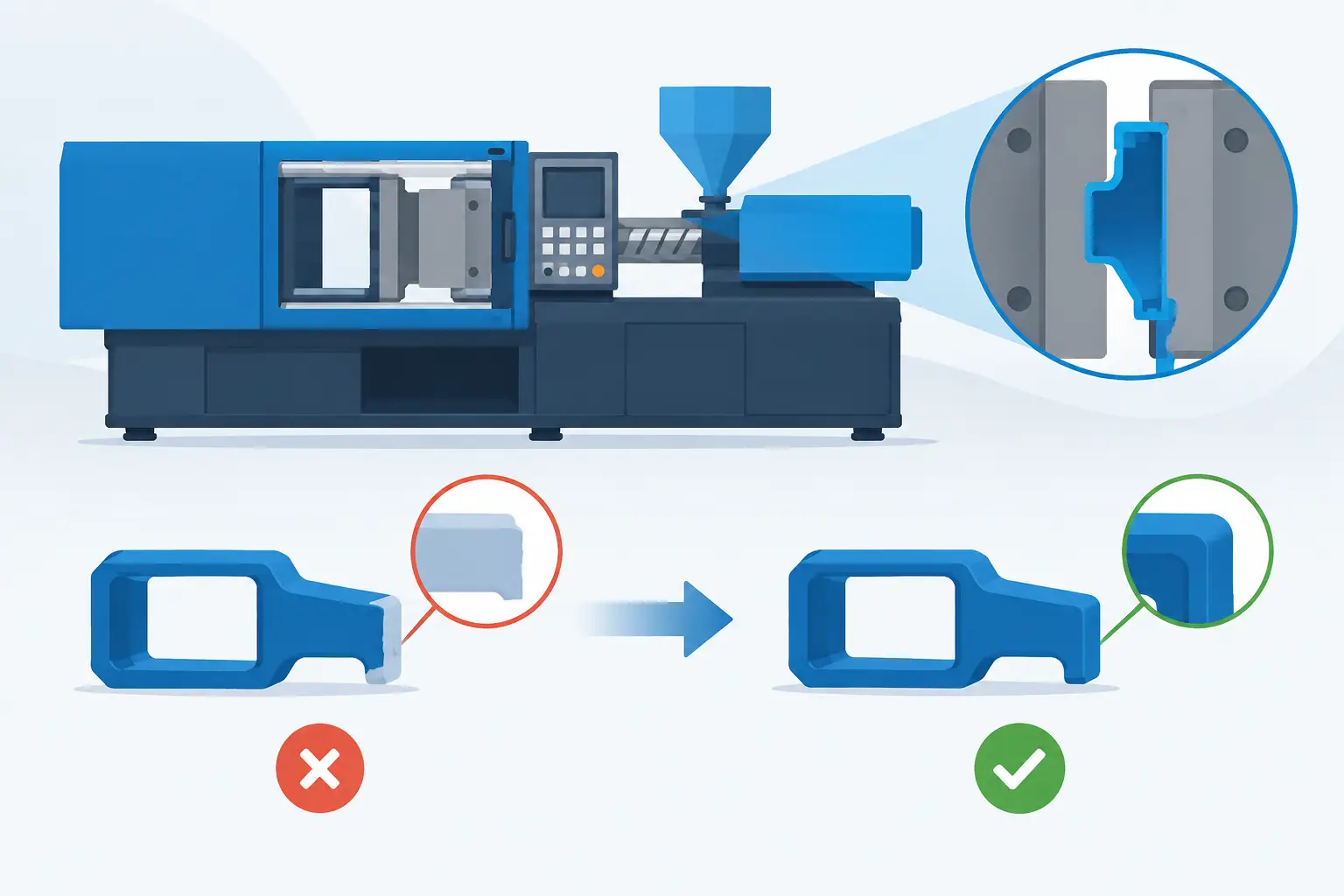
Glass-filled materials, for example, improve stiffness but can change flow behavior and accelerate wear in the tool. Cosmetic materials may require tighter venting and surface preparation. Thin-wall parts may need a resin with better flow to fill consistently without flash or short shots.
That is why experienced manufacturers review the resin and tool strategy together. When design, tooling, and molding are managed as one process, the chance of getting stable production increases significantly.
The real question is what the part must do
If the part is a cosmetic housing, ABS or PC/ABS may be the best fit. If it is a living hinge or cost-driven utility component, PP may be the better answer. If it is a mechanical wear part, POM or nylon may outperform everything else. If impact resistance or transparency is critical, PC may lead.
There is no universal winner because injection molding serves too many different applications. The best material is the one that meets the performance target with the lowest total production risk.
For that reason, serious projects usually begin with application review, resin comparison, and manufacturability analysis rather than a fixed material assumption. At Glasfil, that is often where better outcomes start – not by forcing a standard resin into the job, but by aligning material, tooling, and production requirements early enough to avoid costly corrections later.
What buyers should ask before locking in a resin
Before approving a material, it helps to ask a few direct questions. Does the part need to carry load or simply hold shape? Will it face heat, chemicals, moisture, or UV exposure? Is surface appearance critical? Are tolerances tight enough that shrink variation could create assembly issues? Will annual volumes justify a higher-performance resin if it improves yield and consistency?
These questions sound basic, but they prevent expensive mistakes. Resin selection should support the part’s full life cycle, from mold trials to repeat production and field performance.
A good injection molded part starts with the right plastic, but the right plastic is rarely chosen by name alone. It is chosen by how well it performs in the tool, on the line, and in the real-world application where failure is not an option.
Contact us if you need further help from our consultant