A door handle that looks perfect in CAD can still fail in the field if the resin choice is wrong. In automotive manufacturing, material selection shapes everything from dimensional stability and surface finish to cycle time, warranty risk, and total program cost. That is why choosing the best plastics for automotive components is not a matter of picking the strongest polymer on a datasheet. It is a matter of matching performance, processability, and production realities.
Automotive parts operate in a demanding environment. Heat cycling, UV exposure, vibration, chemical contact, impact loads, and tight cosmetic expectations all push plastic materials in different directions. A resin that performs well for an interior trim clip may be completely wrong for an under-hood housing. The right choice depends on the part’s function, where it sits in the vehicle, the expected production volume, and how tightly the tool and process can be controlled.
What makes the best plastics for automotive components?
For most OEMs and Tier suppliers, the answer starts with application fit rather than price alone. A lower-cost resin can become the expensive option if it creates warpage, sink marks, long cycle times, paint adhesion issues, or assembly failures. On the other hand, specifying an engineering plastic that exceeds the real requirements can drive unnecessary material and tooling costs.
The best plastics for automotive components usually balance six factors: mechanical strength, thermal resistance, chemical resistance, dimensional stability, appearance, and manufacturability. In injection moulding, manufacturability matters more than many sourcing teams expect. Flow behaviour, shrink rate, fibre orientation, mould temperature sensitivity, and post-mould stability all affect whether a part can be produced consistently across repeat runs.
This is where engineering and tooling have to work together. Material selection is not separate from gate location, wall thickness, rib design, texture, or tolerance strategy. In production, those decisions are linked.
The main plastics used in automotive parts
Polypropylene for interior and utility parts
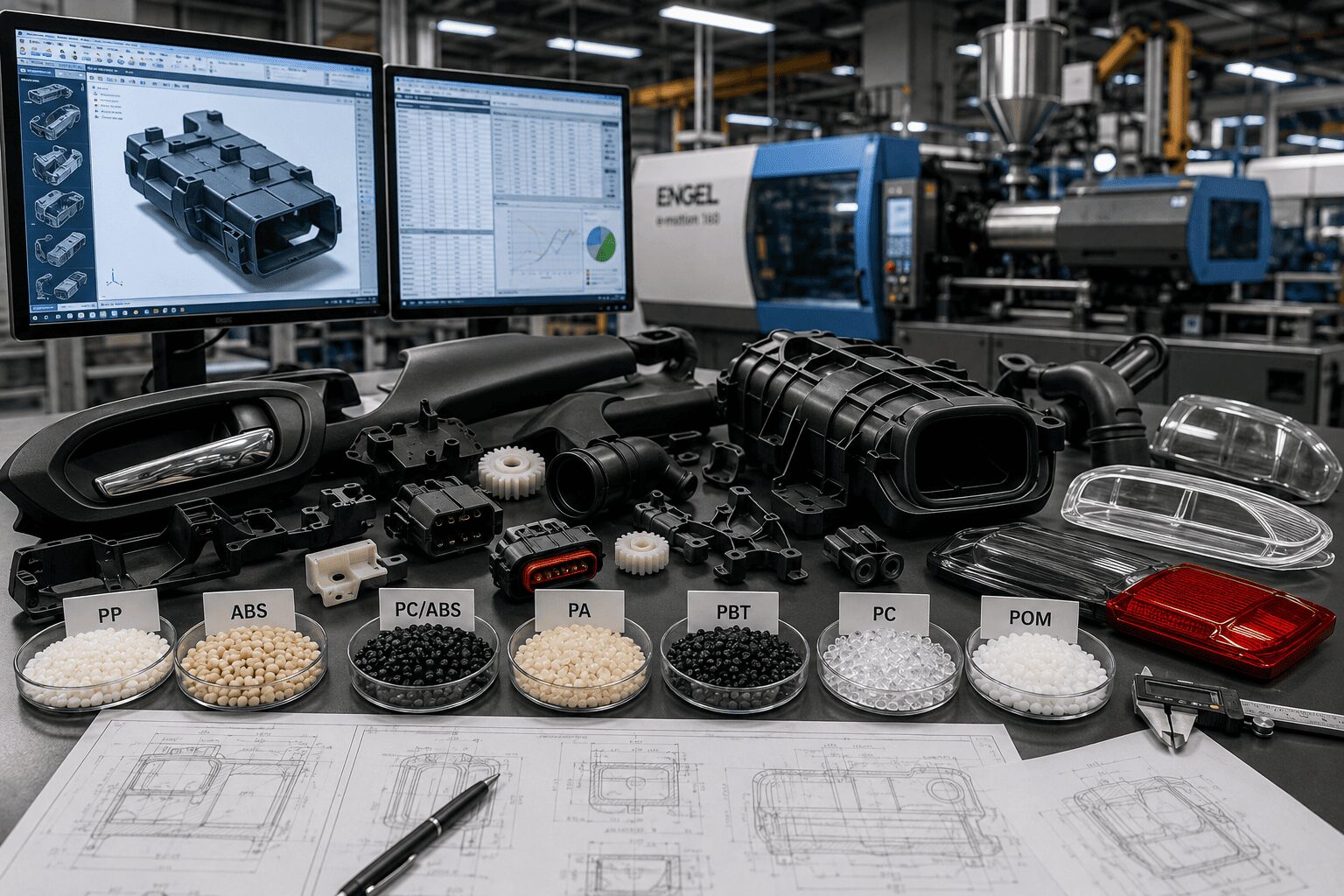
Polypropylene, or PP, remains one of the most widely used automotive plastics because it offers a practical cost-to-performance ratio. It is lightweight, chemically resistant, and well-suited for higher-volume injection moulding. It is commonly used for interior trims, battery covers, ducts, housings, and non-structural components.
Its strengths are clear. PP is economical, processes efficiently, and performs well in applications where moderate heat resistance is acceptable. It can also be modified with fillers such as talc or glass fibre to improve stiffness and dimensional control.
The trade-off is that standard PP is not the right answer for every part. It can struggle where higher impact performance at low temperatures or tighter dimensional tolerance is required. Cosmetic performance is also application-dependent, especially for visible surfaces with demanding texture or gloss standards.
ABS for appearance and rigidity
ABS is commonly selected for interior automotive components where appearance matters. It offers good rigidity, solid impact performance, and a surface quality that works well for visible parts such as trim panels, bezels, and control housings.
From a moulding standpoint, ABS is predictable and useful for parts that need a clean cosmetic finish. It also supports secondary finishing and plating in many applications.
Its limitation is temperature resistance. For parts exposed to elevated under-hood temperatures or aggressive chemicals, ABS is often not sufficient on its own. It is better suited to interior environments or protected assemblies.
PC/ABS for balanced performance
When a program needs better heat resistance and toughness than ABS alone can provide, PC/ABS blends are often a strong option. These materials combine the processability and surface quality of ABS with the impact strength and thermal performance of polycarbonate.
That makes PC/ABS a common choice for instrument panel parts, pillar trims, console components, and other interior applications with higher performance expectations. It is especially useful when the part must maintain its appearance while handling mechanical stress.
The trade-off is cost and processing discipline. PC/ABS is more demanding than commodity resins, and moisture control becomes more important. If drying and moulding parameters are not handled correctly, part quality can suffer quickly.
Polyamide for under-hood performance
Polyamide, usually known as nylon or PA, is one of the strongest candidates for demanding automotive applications. Glass-filled PA grades are widely used in under-hood components, brackets, connectors, covers, and structural housings because they offer strong mechanical properties, good heat resistance, and solid wear performance.
For parts exposed to oils, fuels, and elevated temperatures, PA often provides a reliable engineering solution. It also performs well in components that need stiffness and strength without moving to metal.
Still, nylon is not a universal fix. Moisture absorption affects dimensions and properties, and that has to be considered during design validation and tolerance planning. Tooling and process control also matter because fibre-filled grades can increase wear and influence warpage behaviour.
PBT for electrical and precision parts
Polybutylene terephthalate, or PBT, is frequently used in automotive electrical systems, sensor housings, connectors, and precision components. It offers good dimensional stability, electrical insulation, and chemical resistance, which makes it well suited for technical parts requiring consistent geometry.
PBT can be an excellent fit when performance has to remain stable across varying temperatures and environments. Reinforced grades can further improve strength and stiffness for more demanding designs.
Compared with more general-purpose materials, PBT typically requires a more defined engineering case. It is not chosen for cost-first projects. It is chosen when electrical performance, dimensional accuracy, and environmental resistance justify the resin.
Polycarbonate for transparency and impact
Polycarbonate, or PC, is valued for high impact resistance and optical clarity. In automotive applications, it is used for lenses, transparent covers, and parts that benefit from toughness and appearance.
PC solves specific problems well, but it is sensitive in processing and can be vulnerable to scratching or chemical attack depending on the environment. In many programs, coated surfaces or blended materials are used to improve performance in service.
Acetal for low-friction moving parts
Acetal, also known as POM, is often selected for gears, clips, latches, and mechanical components that require low friction, good fatigue resistance, and dimensional precision. It performs well in moving assemblies where smooth operation matters.
For automotive components with repeated motion or snap-fit demands, POM can be a very efficient material choice. However, it is less suited to highly cosmetic visible parts, and design teams need to account for its processing behaviour early in development.
How to choose the right plastic for the part
The fastest way to make a poor material decision is to choose by generic category alone. “Automotive grade” is not enough. The better approach is to define the actual load case, environment, finish requirement, and assembly method.
Start with where the part lives. Interior, exterior, and under-hood applications have very different temperature and exposure profiles. Then look at what the part must do. Is it carrying load, clipping into another assembly, protecting electronics, or presenting a Class A appearance? Those answers narrow the field quickly.
Next, evaluate production conditions. A resin that looks ideal on paper may create moulding difficulties at scale if wall sections are uneven or the part geometry encourages differential shrinkage. This is why the material decision should be reviewed alongside mould design, expected annual volume, and downstream operations such as welding, plating, printing, or assembly.
Material choice is also a tooling decision
In automotive programs, resin performance and tool performance are closely linked. Glass-filled materials can deliver the stiffness a part needs, but they also change wear patterns inside the mould. High-temperature engineering resins may support the application better, but they can increase cycle time and require tighter thermal management.
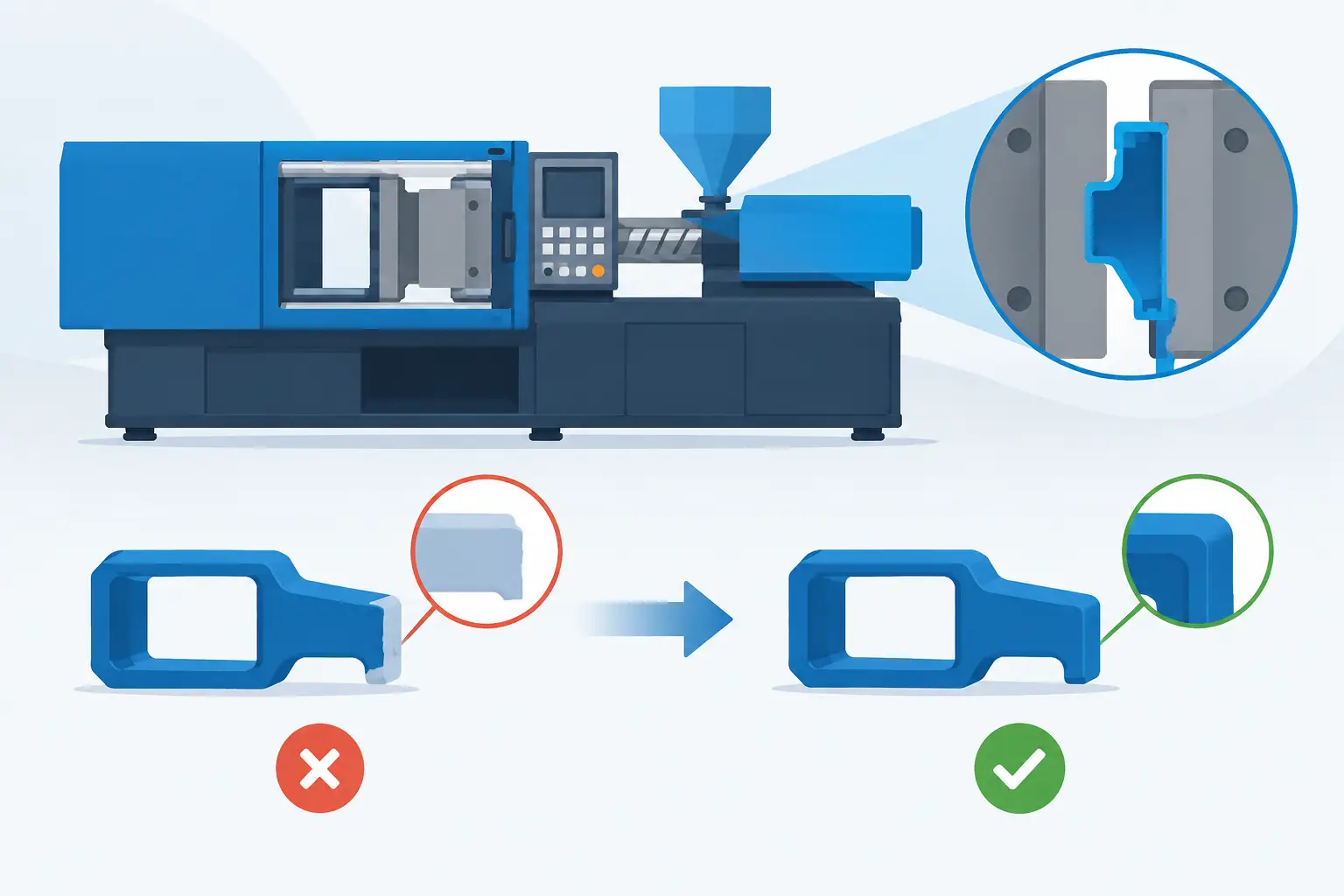
This is one reason integrated manufacturing matters. When tooling, moulding, and quality teams work together from the start, issues like warpage, gate vestige, sink, tolerance drift, and cosmetic defects can be addressed before they become launch problems. For buyers, that reduces the cost of late-stage changes and shortens the path to stable production.
At Glasfil, this kind of coordination is built into the process because mould design, mould modification, moulding, and quality assurance are all handled in-house. That matters when a resin recommendation needs to translate into a part that runs consistently on production equipment, not just in a material comparison sheet.
Common mistakes when selecting automotive plastics
One common mistake is overengineering the resin while underengineering the part design. Another is the reverse – choosing a low-cost plastic for a demanding application and hoping tool adjustments will compensate. Neither approach holds up well in series production.
Another frequent issue is ignoring long-term environmental exposure. Heat ageing, fluid contact, UV resistance, and creep behaviour do not always show up in early prototypes, but they often appear later in validation or field use. Material selection should be based on the full service life of the component, not only the first moulded sample.
A better decision process asks a simple question early: what must this part keep doing after thousands of cycles, months of heat, and repeated assembly stress? That answer usually points to the right polymer family faster than a long list of generic resin properties.
The best automotive plastic is rarely the most expensive or the most familiar. It is the one that fits the part, the tool, the process, and the production target at the same time. When those factors are aligned early, programs move faster, quality stabilises sooner, and the finished component performs the way it should long after it leaves the mould.
Contact us today to request a quote or schedule a discussion with our technical team.