A resin specification can decide whether a package runs consistently at scale or creates avoidable scrap, color variation, and delivery delays. The difference between PCR and virgin plastic packaging is not simply a sustainability claim. It affects material consistency, tool design, process settings, part performance, regulatory requirements, and the commercial risk carried by the buyer.
For OEMs, brand owners, and product teams, the right choice depends on what the package must do. A cosmetic jar, a food-contact closure, an industrial container, and a protective electronics tray may all use plastic, but they do not place the same demands on the material. The practical question is not whether PCR or virgin resin is universally better. It is which resin strategy delivers the required performance with a manufacturable, dependable supply.
What PCR and Virgin Plastic Actually Mean
Virgin plastic is made from newly produced petrochemical feedstock. It has not previously been used in a consumer or industrial product. Resin suppliers formulate virgin grades to defined specifications for melt flow, density, impact strength, color, additives, and regulatory compliance. For injection molded packaging, that consistency is one of its main production advantages.
PCR means post-consumer recycled resin. The feedstock comes from products that consumers have used, discarded, collected, sorted, cleaned, processed, and converted back into usable plastic resin. Common PCR streams include recycled PET, HDPE, PP, and LDPE from bottles, containers, caps, films, and other household packaging.
PCR is different from post-industrial recycled material. Post-industrial material, sometimes called PIR, comes from manufacturing scrap that is recovered before reaching a consumer. Because it has a known origin and a more controlled collection path, PIR can be easier to manage than PCR. Buyers should not treat the terms as interchangeable when setting recycled-content targets or approving material specifications.
Difference Between PCR and Virgin Plastic Packaging in Production
The central manufacturing difference is variation. Virgin resin begins with a controlled formulation. PCR begins with a recovered material stream, so its properties can vary by collection source, sorting quality, processing method, and batch. Reputable recyclers use sorting, washing, filtration, compounding, and quality testing to reduce that variation, but it cannot be assumed away.
Material consistency and part performance
Virgin resin generally provides the most predictable mechanical and processing behavior. It is often the safer choice for thin walls, tight dimensional tolerances, demanding snap fits, living hinges, high-gloss surfaces, and components exposed to impact, chemicals, heat, or repeated use. It also gives engineers a wider choice of specialized grades, such as flame-retardant, UV-stabilized, reinforced, or high-clarity materials.
PCR can perform very well in the right application, particularly where the part geometry is forgiving and the recycled resin has been qualified for the intended use. However, recycled polymers may have shorter molecular chains after prior processing and use. Depending on the polymer and recycling process, this can affect impact resistance, stiffness, elongation, melt flow, and long-term durability.
A package does not have to fail catastrophically for this to matter. A small shift in shrinkage can affect cap fit. A change in melt flow can alter fill balance across a multi-cavity tool. Lower impact performance can increase breakage during shipping. These are engineering variables that should be tested against the actual part, not judged from a generic resin data sheet alone.
Appearance, color, and odor
Virgin material provides the cleanest path to consistent color, transparency, and surface finish. Natural virgin resin can be made clear or brightly colored with reliable results, which is why it remains common for premium packaging, medical-adjacent applications, and visible consumer products.
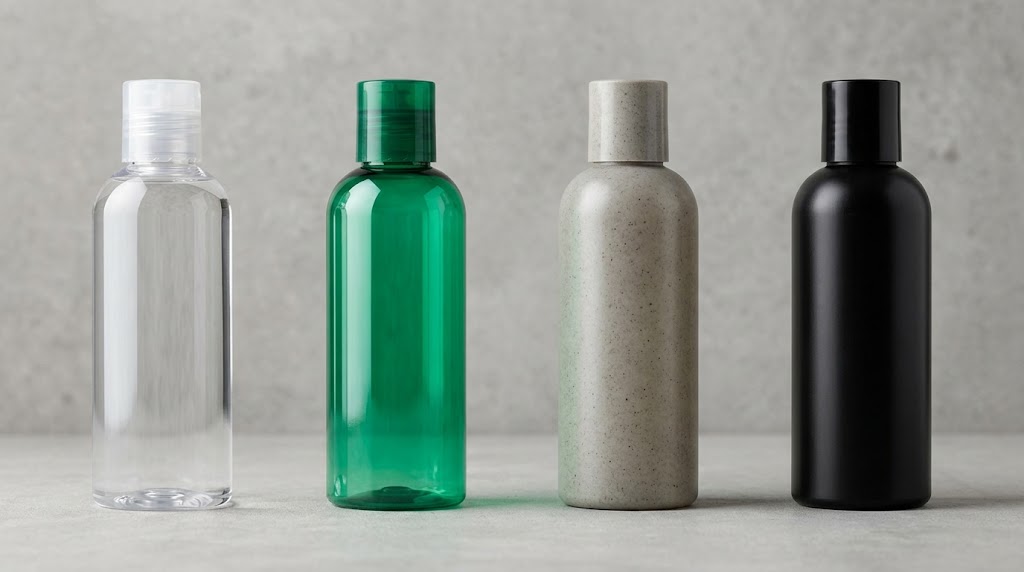
PCR frequently has a gray, off-white, or slightly variable base color. Darker colors can mask variation effectively, while white, pastel, metallic, and transparent finishes are more challenging. A recycled-content package can still look excellent, but it may require color development, masterbatch adjustments, or a design that works with the resin rather than fighting it.
Odor is another qualification point. The recycling and deodorization process has improved substantially, yet some PCR grades can retain trace odors from previous contents or processing. For fragrance-sensitive products, personal care packaging, or food-related applications, odor testing should be part of material approval.
Processing and tooling requirements
PCR does not automatically require a new mold, but it may require a different process window. Drying requirements, melt temperature, back pressure, injection speed, hold pressure, and cooling time may need adjustment. The degree of change depends on the polymer, recycled-content percentage, additive package, and part design.
Tooling should be designed for repeatable production, not just a successful first trial. Gate size, venting, flow length, wall transitions, and ejection must support the selected resin’s flow and shrink behavior. Where a customer wants to move an established virgin-resin part to PCR, a molding trial and dimensional review are usually more valuable than broad assumptions about drop-in replacement.
At Glasfil, in-house tool modification capability allows material-driven adjustments to be evaluated without separating mold ownership, engineering feedback, and production execution across multiple suppliers. That matters when the project schedule depends on resolving a real molding issue quickly.
Recycled Content Is Not a Single Material Choice
A request for “PCR packaging” needs more detail before it becomes a production specification. PCR content may range from a modest percentage to a high-content formulation, and results change as the percentage rises. A part using 10% PCR may retain behavior close to its virgin equivalent. A part using 50% or 100% PCR may need more extensive validation, depending on resin quality and functional demands.
The source polymer matters just as much. Recycled HDPE, PP, PET, and LDPE have different processing routes and end-use strengths. A detergent bottle, a hinged cap, and a clear thermoformed tray cannot be evaluated through the same material lens. For injection molded rigid packaging, recycled PP and HDPE are often relevant options, but grade selection must follow the performance requirements of the specific component.
Some applications also benefit from a hybrid approach. A brand may use PCR in a non-critical outer component while retaining virgin resin in a functional closure, dispensing feature, or barrier-sensitive layer. This can reduce virgin-plastic use without transferring excessive risk to the most demanding feature of the package.
Cost and Supply: Look Beyond the Resin Price
PCR is often assumed to be cheaper because it is recycled. In practice, pricing can move in either direction. Collection, sorting, washing, decontamination, compounding, certification, and demand for high-quality recycled feedstock all influence cost. A consistent, color-controlled, food-contact-compliant PCR grade may carry a premium over a standard virgin grade.
Supply planning deserves equal attention. PCR availability can vary by region, polymer type, color, certification status, and contracted volume. If recycled content is a firm brand commitment, it should be integrated into sourcing early, not added after tooling is complete. A qualified primary grade and an approved alternative grade can protect production against disruptions.
The lowest per-pound resin cost is not necessarily the lowest landed cost. Higher scrap rates, longer cycle times, extra color correction, rejected cosmetic parts, or inconsistent deliveries can erase a material-price advantage. Production teams should compare total manufacturing performance: yield, cycle time, quality results, logistics, and the cost of qualification.
Regulatory and Claims Considerations
For packaging that contacts food, beverages, pharmaceuticals, or sensitive personal care products, material selection must account for the relevant regulatory pathway. Not every PCR grade is suitable for direct food contact, and approval requirements depend on the polymer, recycling process, intended conditions of use, and market where the product will be sold.
Environmental claims require the same discipline. “Made with recycled content” should be supported by supplier documentation and a clear definition of the percentage and material basis. Buyers should confirm whether the stated percentage applies to the whole package, one component, total plastic weight, or a specific resin layer. Recycled-content claims that are vague or poorly documented create unnecessary commercial and compliance exposure.
A Practical Material Approval Process
Material approval works best when it begins before final tooling release. Start with the functional requirements: load, impact, chemical exposure, temperature, appearance, color, barrier needs, contact requirements, and expected product life. Then identify the recycled-content target and determine whether it is mandatory, preferred, or flexible.
Next, review resin data from more than one qualified supplier where possible. A data sheet is a starting point, not final proof. Mold samples should be inspected for color, flow marks, splay, warpage, sink, dimensional stability, assembly fit, odor, and any property that matters in service. For repeat programs, retain approved samples and document the process window so future production is controlled against a known standard.
Finally, involve molding and tooling engineers early. Material, part geometry, mold design, and production settings operate as one system. A resin change made late in development can create preventable changes to cycle time, quality controls, and tool requirements.
PCR can be a strong commercial and environmental choice when the material is matched to the application and qualified under real production conditions. Virgin resin remains the right answer where performance, appearance, compliance, or process stability leaves little room for variation. The most effective packaging programs set measurable requirements first, then select the resin that can meet them consistently at production scale.
Turn Design Concepts into Shelf-Ready Packaging
At Glasfil, we bring design, mold fabrication, injection molding, and quality testing under one roof. By testing materials directly against custom tooling, we help cosmetics brands introduce PCR, cut packaging weight, and protect product aesthetics—without supply chain risks or unexpected costs.
Ready to upgrade your cosmetic packaging? Contact us today to evaluate your design and run a trial with sustainable materials.