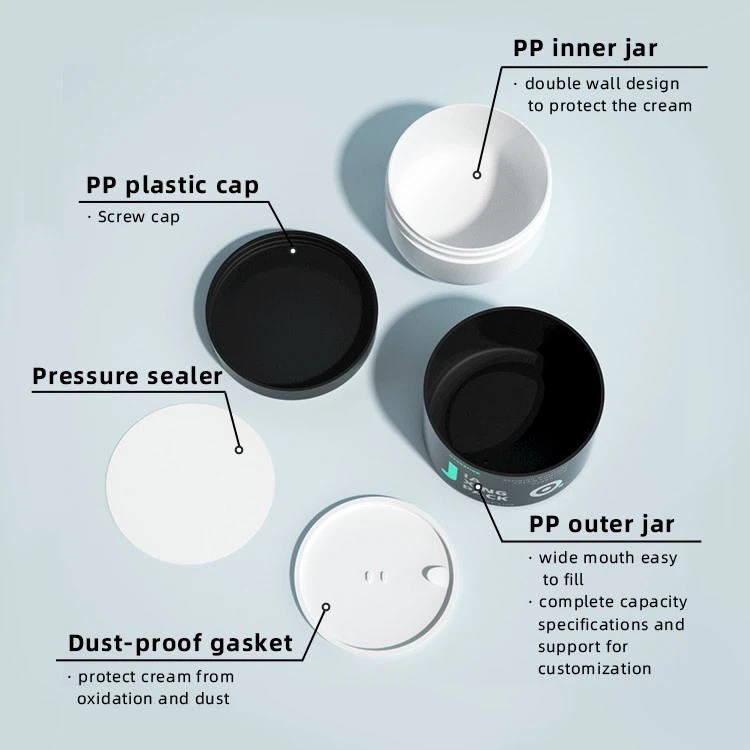
A premium cosmetic pack can fail its sustainability brief because of a single hidden component. A PP jar with a different-material liner, metalized cap insert, adhesive label, or elastomer seal may look recyclable on a specification sheet, yet become difficult to sort and process in practice. Mono-material cosmetic packaging addresses this problem by designing the pack as a material system, not simply choosing a recyclable resin for its main body.
For product developers, procurement teams, and cosmetic brands, the objective is clear: reduce material complexity without compromising dispensing, compatibility, appearance, shelf life, or production reliability. Achieving that balance requires early engineering decisions. It cannot be added at the final packaging stage.
What Mono-Material Cosmetic Packaging Means
Mono-material packaging is built predominantly from one polymer family. In cosmetics, polypropylene (PP) and polyethylene (PE) are common starting points because they are widely used in rigid packaging and can support injection-molded formats such as jars, caps, closures, compacts, sticks, and selected dispensing components.
The term does not require every gram of a pack to be chemically identical. Pumps, spring mechanisms, certain applicators, and barrier-sensitive products can make that unrealistic. The practical goal is to minimize incompatible materials, maximize the proportion of one recyclable polymer stream, and make unavoidable exceptions easy to separate or appropriately managed.
This distinction matters. A container made from one material but paired with a permanently attached, incompatible closure is not a fully resolved mono-material design. The entire consumer-facing assembly must be reviewed: vessel, cap, lid, hinge, insert, wiper, label, decoration, seal, and any secondary component that stays with the pack through disposal.
Why Cosmetic Packaging Is a Difficult Case
Cosmetics place more demands on packaging than many dry consumer goods. Formulas may contain oils, alcohol, waxes, active ingredients, fragrances, pigments, or volatile compounds. A pack must protect the formula, preserve its appearance, and function consistently from the first use to the last.
At the same time, beauty products are judged visually and tactually. Consumers expect clean closure action, controlled dispensing, premium surfaces, accurate color, and decoration that survives handling. Replacing a mixed-material assembly with a single-polymer approach may change stiffness, gloss, hinge behavior, chemical resistance, or perceived quality. These are engineering variables, not reasons to avoid the project.
The answer depends on the product format. A simple cream jar offers a different design path from a mascara pack, an airless dispenser, or a lipstick mechanism. Mono-material cosmetic packaging is most effective when the pack architecture matches the product’s actual performance requirements instead of copying a legacy design built from multiple materials.
Start With the Full Component Map
Before selecting resin or requesting tooling, map every component in the pack and identify its function. This should include pieces that are easy to overlook, such as inner plugs, tamper bands, cap inserts, decorative overcaps, applicator holders, and labels.
For each component, ask three direct questions: Does it need to be a different material? Can its function be achieved with the primary polymer? If it must remain different, can the consumer remove it without tools?
This exercise often identifies the fastest improvements. A separate cap insert may be redesigned as an integral feature. A metalized decorative shell may be replaced with molded texture, color, embossing, or a compatible decoration process. A label may be reduced in size or replaced with direct marking where regulations and branding allow.
A component map also prevents misleading claims. If a package is marketed as mono-material while containing a substantial mixed-material mechanism, procurement and sustainability teams need a clear technical explanation of the limitation. Credibility comes from measured improvement, not broad language.
Material Selection Must Follow Formula Testing
PP is often selected for cosmetic jars, caps, and closures because it provides useful stiffness, good molding performance, and broad design flexibility. PE can be a strong choice for squeeze-oriented formats and components requiring greater flexibility. However, material selection should never rely on general compatibility assumptions alone.
Formula-packaging interaction testing is essential. Oils can affect stress cracking behavior. High fragrance loads can create odor migration or material changes. Alcohol-containing products may require additional scrutiny. Pigments, UV exposure, temperature cycling, and repeated opening cycles can also affect long-term performance.
For a molded cosmetic component, the resin grade, color masterbatch, wall thickness, gate location, and surface finish all influence the result. A change intended to improve recyclability can introduce warpage, shrink variation, poor thread fit, or a visible weld line if it is not considered alongside tool design and processing conditions.
This is why early collaboration between packaging designers, material suppliers, moldmakers, and molders is more efficient than sequential handoffs. The design must be manufacturable at the target volume, not merely attractive in a render.
Tooling Decisions Shape Recyclability and Quality
Mono-material designs frequently require functional features to be molded into the part rather than added later. Living hinges, snap fits, tamper evidence, sealing geometries, and retention features can reduce the need for separate inserts or assembly operations. These features place greater importance on precise mold design and material flow control.
Wall thickness must support both aesthetics and production stability. Thick sections may create sink marks and longer cooling times. Thin sections can challenge filling, especially around hinges, threads, or fine decorative texture. A part that appears simple may require carefully placed gates, controlled cooling, and optimized ejection to maintain dimensional consistency.
The mold should also anticipate future modifications. Cosmetic brands regularly update decoration, color, capacity, or closure details. In-house tool modification capability can reduce disruption when a validated design needs refinement, rather than forcing a full restart with a new supplier.
At Glasfil, this integrated approach connects part design, mold fabrication, injection molding, finishing, and quality control in one production flow. For packaging programs with compressed launch timelines, technical control over these stages helps resolve issues before they become supply-chain delays.
Do Not Trade Performance for a Simplified Material Story
A mono-material solution should improve the packaging system without creating a worse user experience or a higher risk of product waste. If a closure leaks, a cap cracks, or a dispenser leaves significant formula behind, the environmental benefit becomes harder to defend.
Barrier performance is a common trade-off. Some formulas require layers, coatings, or materials that do not align easily with a single-polymer structure. In these cases, the most responsible option may be a reduced-complexity design rather than an absolute mono-material claim. The right decision is based on product protection, recovery pathways, and total system performance.
Decoration requires the same discipline. Heavy metallization, incompatible inks, and large adhesive labels can interfere with recycling outcomes. Yet cosmetic packaging still needs shelf impact and brand distinction. Molded-in texture, debossed graphics, compatible color strategies, and restrained use of decoration can retain a premium result while avoiding unnecessary complexity.
Design for Real Disposal Behavior
Recyclability is not determined at the molding machine. It depends on local collection, sorting technology, package size, consumer behavior, and end-market demand for recovered material. A tiny component made from a recyclable resin may still be missed by sorting equipment. A cap that consumers routinely discard separately may not stay with its matching container stream.
This does not reduce the value of mono-material design. It makes thoughtful design more necessary. Brands should consider the markets where the product will be sold, whether components are likely to remain attached, and whether the selected material aligns with established recovery systems. Claims should reflect those conditions accurately.
For global programs, one material architecture may not produce identical end-of-life results in every country. The practical target is a package that is materially simpler, technically sound, and compatible with the best available collection and sorting routes in its intended markets.
A Better Development Path for Cosmetic Brands
The strongest projects start by setting a clear hierarchy of requirements. Formula protection and safety come first. Then come functional performance, manufacturability, aesthetic requirements, recyclability goals, unit cost, and launch timing. These priorities should be documented before final industrial design approval.
Prototype parts are valuable because they reveal problems that drawings cannot. Thread feel, cap torque, hinge fatigue, label placement, parting-line visibility, and color consistency are experienced physically. Testing should cover the formula, transport conditions, repeated consumer use, and production-level dimensional variation.
Once the design is validated, process discipline protects the result. Consistent resin handling, controlled molding parameters, visual inspection, dimensional checks, and assembly verification are particularly important for cosmetic components where small defects are highly visible. A well-designed mono-material pack only delivers its intended value when repeat production holds the same fit, finish, and function.
The useful question is not whether every cosmetic package can become perfectly mono-material. It is whether each component earns its material choice. When design, tooling, material behavior, and end-of-life reality are evaluated together, cosmetic packaging becomes simpler to manufacture, easier to explain, and better prepared for the standards buyers and consumers increasingly expect.
Turn Design Concepts into Shelf-Ready Packaging
At Glasfil, we bring design, mold fabrication, injection molding, and quality testing under one roof. By testing materials directly against custom tooling, we help cosmetics brands introduce PCR, cut packaging weight, and protect product aesthetics—without supply chain risks or unexpected costs.
Ready to upgrade your cosmetic packaging? Contact us today to evaluate your design and run a trial with sustainable materials.