A runner system can determine whether a moulded part is economical at 10,000 units or 10 million. The hot runner vs cold runner decision affects more than the mould quote. It changes resin consumption, cycle time, automation requirements, maintenance planning, part appearance, and the risk profile of the production launch. For buyers sourcing custom plastic components, the right answer depends on the part, polymer, annual volume, and the production controls available after the tool is built.
What Is the Difference Between Hot Runner and Cold Runner?
Both systems move molten plastic from the injection moulding machine nozzle to the mould cavities. The difference is what happens to the material in that path.
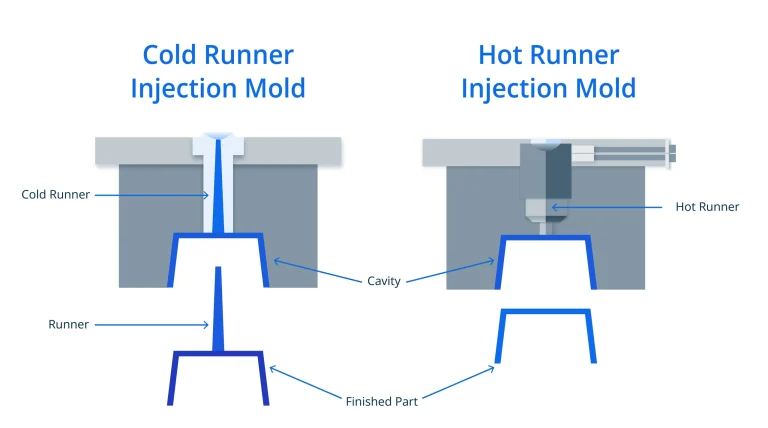
A cold runner is an unheated channel machined into the mould plates. Plastic fills the runner and cavities during injection, then cools and solidifies with the part. When the mould opens, the runner is ejected alongside the moulded component. It may be reground and reused when the material and quality requirements allow, or it becomes scrap.
A hot runner uses heated manifolds and nozzles to keep the plastic in the feed system molten between shots. Only the finished parts are ejected. The runner does not solidify, which can reduce material loss and eliminate a secondary separation step.
Neither system is automatically superior. A cold runner is often the more practical choice for lower-volume programs, technically sensitive materials, and tools where purchase cost matters most. A hot runner can be the stronger production investment when resin savings, cycle performance, and automated high-volume output justify its higher complexity.
Where Hot Runner Systems Create Value
The most visible benefit of a hot runner is reduced material waste. In a cold runner mould, every shot includes a runner. On a small, lightweight part, the runner can weigh as much as the product itself. Over a long production run, that material adds cost, handling, and potential quality variation if regrind is introduced.
Hot runner moulds also support cleaner automation. With no runner to separate, a robot or conveyor system handles fewer items per cycle. This can simplify downstream operations, particularly for parts that are packed automatically or sent directly into assembly.
Cycle time may improve as well. A cold runner must cool sufficiently to eject as a stable piece, even though it is not the sellable product. Removing that cooling requirement can shorten the cycle in some applications. The actual gain depends on part wall thickness, gate design, resin behaviour, and mould cooling performance. A hot runner does not compensate for poor cooling channels or a part design with excessive wall sections.
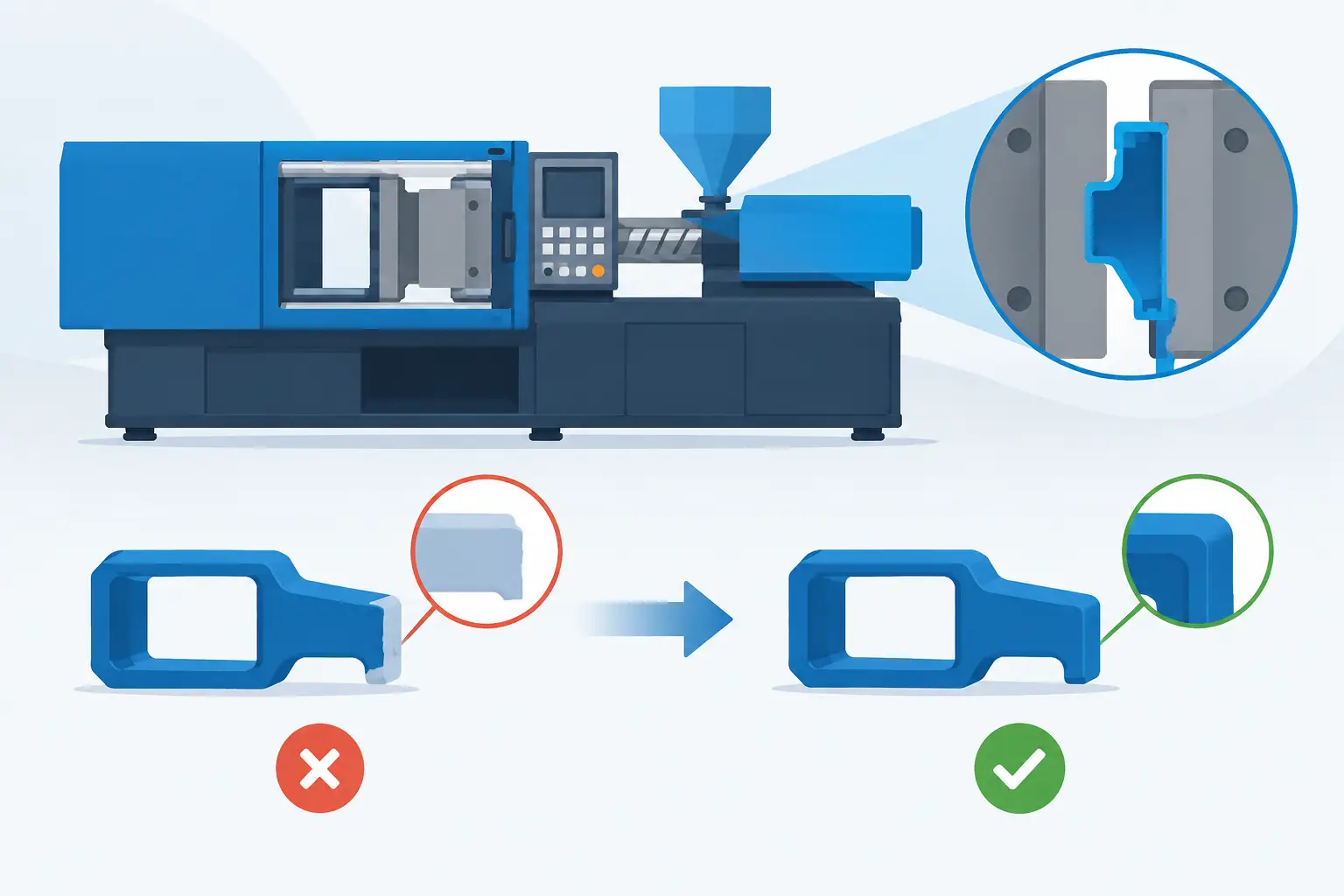
For multi-cavity moulds, hot runner systems can provide more direct control over filling and gating. Valve-gated hot runners can improve gate vestige, control injection sequence, and support challenging cosmetic requirements. This is especially useful for visible automotive, electrical, bathroom accessory, and consumer-facing components where gate location and surface quality matter.
The trade-off is tooling investment. Heated manifolds, nozzles, temperature controllers, wiring, and more precise system integration increase the initial cost. They also add components that require knowledgeable maintenance and disciplined process setup.
When a Cold Runner Is the Better Tooling Choice
Cold runner moulds remain a sound manufacturing solution because they are simple, durable, and economical. The mould construction is less complex, the initial investment is lower, and troubleshooting is generally more straightforward. For a new product with uncertain demand, this can protect the buyer from overinvesting in tooling before volumes are proven.
Cold runners are also useful with materials that have narrow processing windows or are sensitive to extended heat exposure. A hot runner holds material at processing temperature between injection cycles. If production stops unexpectedly or the residence time becomes excessive, some resins can degrade, discolour, or lose performance. A properly designed cold runner avoids this specific risk because the material solidifies after each shot.
Runner regrind can improve the economics of a cold runner program, but it must be controlled. Some materials tolerate a measured percentage of clean, traceable regrind. Others, including many filled, reinforced, cosmetic, or tightly specified resins, may require virgin material or have strict limits on reprocessed content. Regrind should never be treated as free material. It can affect moisture control, flow behaviour, colour consistency, mechanical properties, and lot traceability.
A cold runner may also be preferable when colour changes are frequent. Purging a hot runner system takes time and material, particularly with deep manifolds or difficult colour transitions. A cold runner tool is usually faster to clean and restart for short runs across multiple colours.
Hot Runner vs Cold Runner: Decision Factors That Matter
The correct runner system should be selected during mold design, not added as a late cost-saving measure. A low tool price can produce higher unit costs for years, while an expensive hot runner can be unnecessary if the program never reaches its planned volume.
Production Volume and Resin Cost
Start with annual demand, expected product life, part weight, runner weight, and resin price. The basic question is whether runner waste will exceed the added cost of the hot runner over the life of the program.
For example, a large runner made from an engineered resin can create a strong financial case for hot runner tooling at moderate volume. Conversely, a low-cost commodity resin on a short production run may not recover the investment. The calculation should include scrap handling, regrind limits, colour change losses, labour, and the expected number of production cycles, not resin cost alone.
Part Geometry and Gate Requirements
The runner system influences where and how plastic enters the part. Cold runners offer considerable flexibility, including edge, tab, fan, and submarine gates. They work well for many standard industrial components and can be designed to support balanced filling across multiple cavities.
Hot runner nozzles are valuable when direct gating is required or when the part cannot accommodate a conventional runner layout. They can reduce flow length, improve cavity layout efficiency, and place gates closer to the areas that need material pressure. However, the gate strategy must still account for weld lines, packing, shrinkage, warpage, and cosmetic marks.
Material Behavior
Material selection deserves early engineering review. Commodity polymers, filled compounds, flame-retardant grades, high-temperature materials, and colour-sensitive resins do not behave the same way in a heated manifold. Glass-filled materials may increase wear. Heat-sensitive materials may demand strict residence-time control. Some polymers require specialised nozzle designs to prevent drool, stringing, freeze-off, or degradation.
A runner choice that works for polypropylene may be unsuitable for a glass-filled nylon housing or a cosmetic ABS component. The mould maker, moulder, and material supplier should align on the resin grade before finalising the system.
Maintenance Capability and Production Continuity
Hot runners require preventive maintenance. Heaters, thermocouples, wiring, nozzles, and manifold interfaces need inspection and documented service. A failed heating zone can stop a production cell, and repair may require trained technicians, spare components, and careful mould disassembly.
Cold runner systems have fewer active components, which reduces this maintenance burden. They still require proper care: gates wear, surfaces can corrode, ejector systems need attention, and runner dimensions must remain consistent. The difference is that a cold runner typically has fewer failure points during operation.
For this reason, a hot runner should be paired with a manufacturing partner that can support tooling maintenance, process monitoring, and rapid corrective action in-house. At Glasfil, mold design, fabrication, modification, moulding, and repair are kept under direct operational control, helping customers make runner-system decisions based on long-term production realities rather than a tooling quote alone.
Build the Business Case Before Cutting Steel
The runner system should be part of a full manufacturability review. Evaluate the part design, resin, target volume, automation plan, quality requirements, and projected lifecycle together. Ask for a comparison that shows tooling cost, shot weight, runner-to-part ratio, anticipated cycle time, scrap assumptions, maintenance needs, and estimated unit economics at several volume levels.
That analysis often reveals a clear direction. A cold runner may be the disciplined choice for a lower-volume industrial component. A hot runner may deliver better economics for a high-volume part with expensive resin, strict cosmetic requirements, or automated assembly. The best mould is not the one with the most advanced specification. It is the one engineered to produce consistent, qualified parts at the cost and speed your program requires.
Contact us today to request a quote or schedule a discussion with our technical team.