A plastic part can look right on the first sample and still fail where it matters most – at assembly, under load, or six months into field use. That is why understanding how to validate plastic parts is not a paperwork exercise. It is a production decision that protects tooling investment, launch timing, and long-term part performance.
For OEMs, product developers, and procurement teams, validation has one job: prove that the part can be made repeatedly, within specification, and in the real conditions it will face. A part that passes a visual check but shifts dimensionally after conditioning, warps during assembly, or varies between cavities is not validated. It is only partially checked.
What does validation mean in plastic part production
Validation is the structured process of confirming that a plastic part meets design intent, material requirements, functional performance, and manufacturing consistency. In injection moulding, the process usually starts before steel is cut and continues through prototype review, first article inspection, process adjustment, and production approval.
This matters because plastic parts do not behave like machined metal components. Resin shrinkage, gate location, wall thickness variation, cooling balance, mould venting, and processing conditions all influence the final result. Two parts moulded from the same tool can still perform differently if the process window is not controlled.
A proper validation plan looks at the part as a manufactured product, not just a CAD file. That means checking geometry, but also checking how the part fills, cools, ejects, assembles, and performs over time. If any one of those areas is ignored, expensive problems usually show up after launch, when changes are slower and costlier.
How to validate plastic parts before production ramps
The most effective validation starts early, when design and tooling decisions are still flexible. Waiting until the first moulded parts arrive creates avoidable risk because many defects are already designed in by then.
Start with the critical requirements
Every part has dozens of dimensions, but only a smaller group truly controls performance. These are the features tied to fit, sealing, movement, load-bearing, appearance, electrical behaviour, or downstream assembly. Validation should begin by separating critical requirements from general drawing data.
This sounds simple, but it is where many programs lose time. If every feature is treated with equal importance, teams spend energy measuring what does not affect function while missing the dimensions that actually drive rejection rates. A good validation plan identifies what must be held tightly, what can float within a broader tolerance, and what depends on the moulding process itself.
Material selection also belongs in this stage. Validation is not only about whether the part shape is correct. It also confirms that the selected resin grade, additives, fillers, and colour system support the real application. A part moulded in the wrong material may still pass initial dimensional checks and fail later in impact resistance, heat stability, chemical exposure, or creep behaviour.
Validate the design for moulding, not just for use
A part can be functionally correct and still be difficult to mould consistently. Thin-to-thick transitions, unsupported ribs, sharp corners, poor draft, cosmetic surfaces near gates, and unrealistic tolerances all create risk. Before production validation begins, the design should be reviewed for moldability.
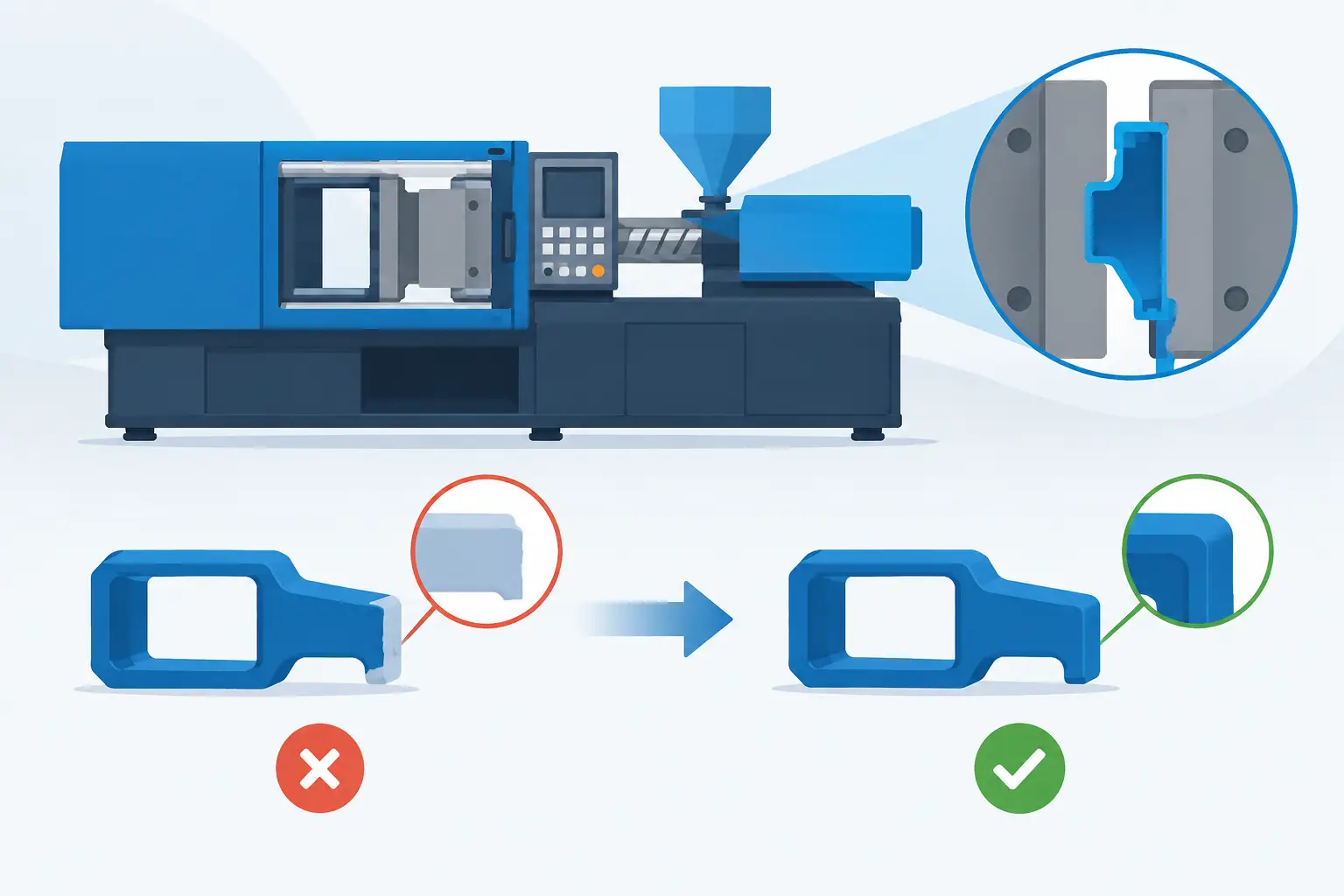
This is where engineering experience matters. A CAD model may appear complete, but injection moulding introduces process realities that must be accounted for. Sink marks, weld lines, flash, short shots, trapped gas, and ejection stress do not happen by accident. They usually trace back to part design interacting with tooling and process conditions.
When design review is handled early, the validation phase becomes faster and more useful. Instead of using first samples to discover preventable issues, the team can focus on confirming process capability and part performance.
The core checks in the plastic part validation
Once moulded samples are available, validation moves from prediction to evidence. At this stage, the objective is to prove that the part meets the specification under controlled manufacturing conditions.
Dimensional validation
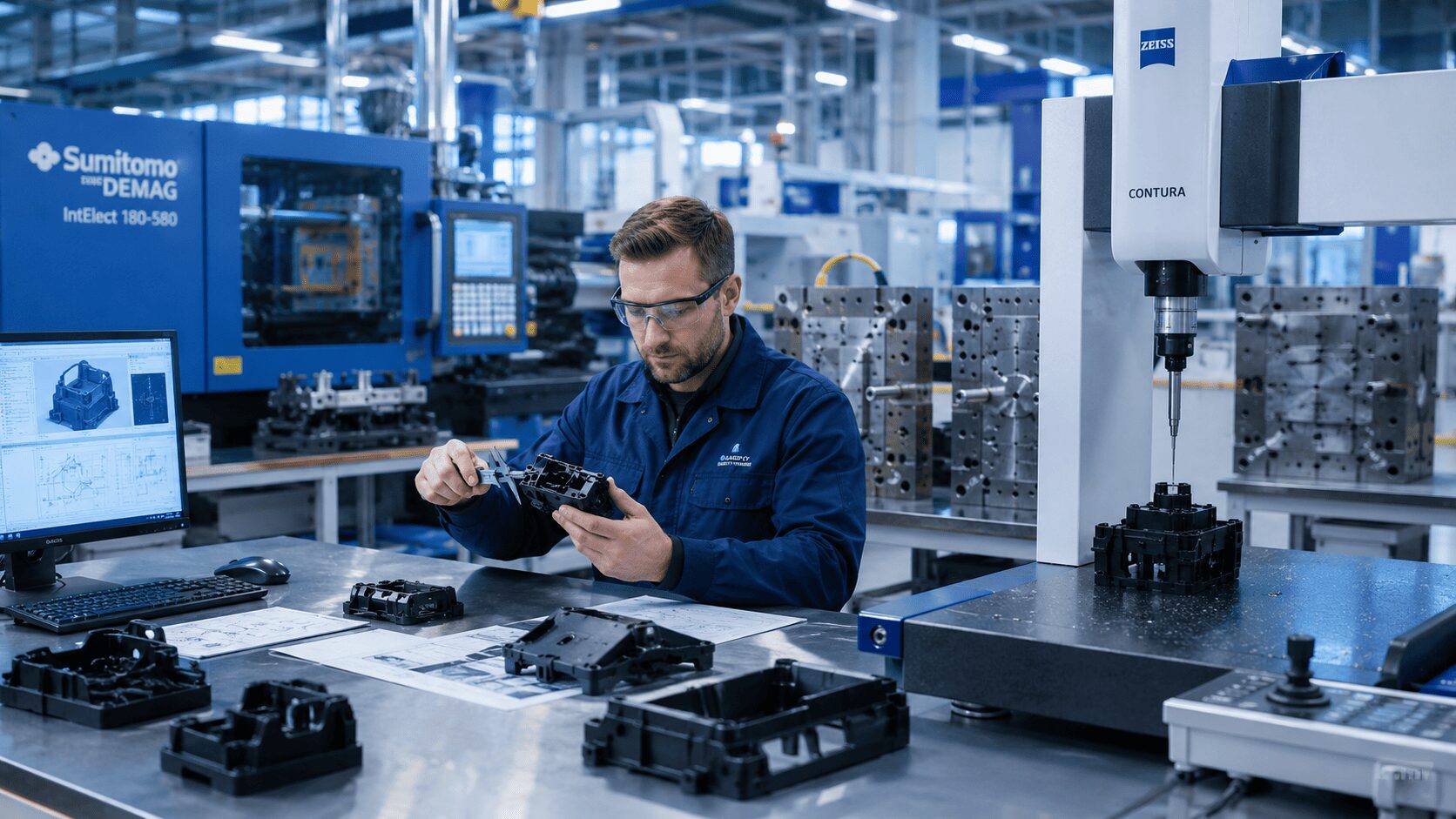
Dimensional inspection is the most visible part of validation, but it should never be the only part. Measured data confirms whether the moulded part matches drawing intent after shrinkage and cooling. Critical dimensions should be checked using the right method for the geometry, whether that means CMM inspection, functional gauges, optical measurement, or calibrated hand tools.
The timing of measurement matters. Some plastic parts continue to stabilise after moulding, especially hygroscopic materials or parts with tighter tolerances. If dimensions are taken too early, the data may not reflect the true production condition. Validation should define when the part is measured and under what environmental conditions.
This is also where cavity-to-cavity variation needs attention. A multi-cavity tool can produce acceptable average data while one cavity drifts out of tolerance. If the validation sample does not trace results by cavity, hidden risk remains in the process.
Material validation
Material validation confirms that the moulded part matches the approved resin specification. That includes the base polymer, filler content where applicable, colour, and any functional requirements such as flame rating, UV resistance, or food-contact compliance.
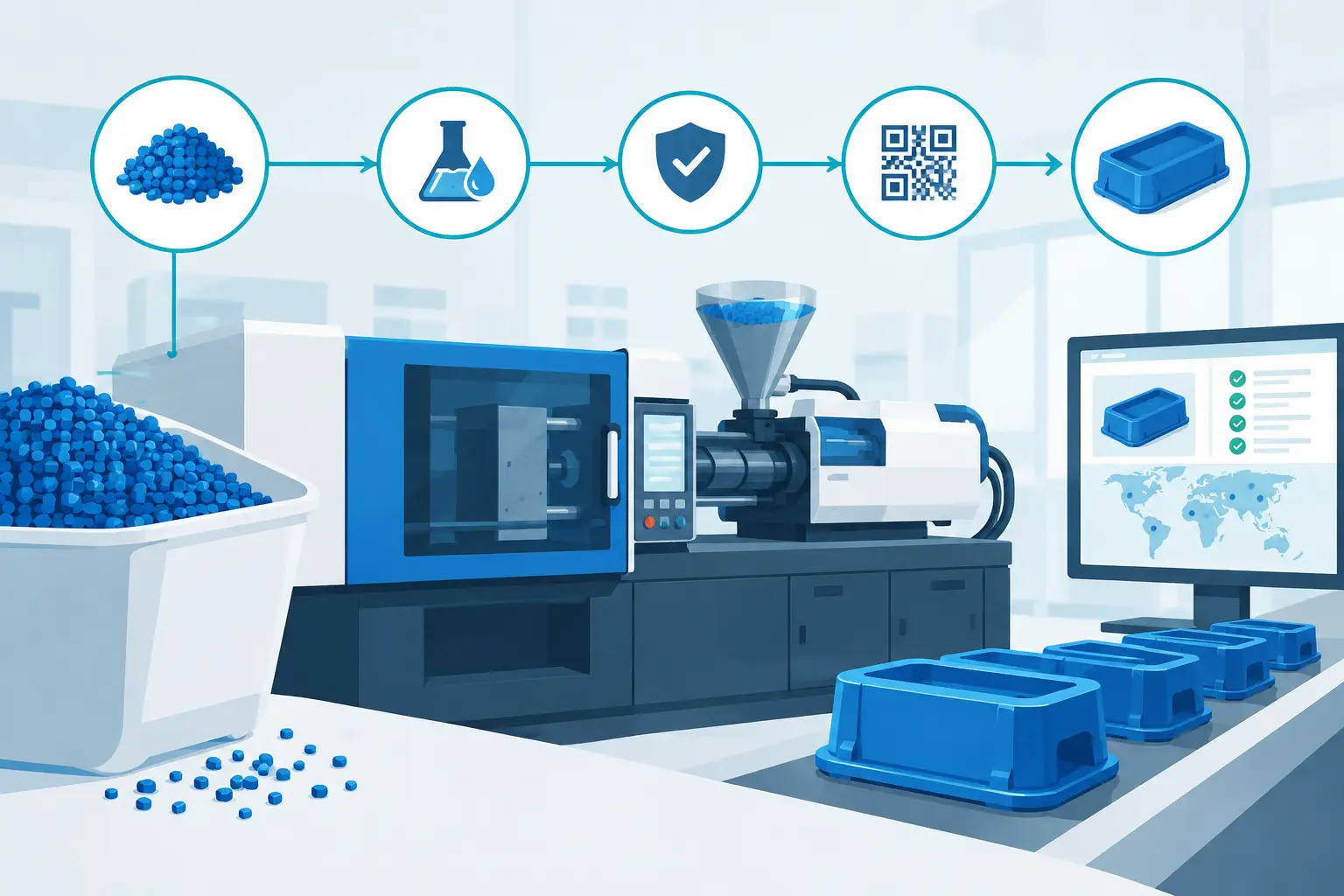
For many industrial parts, this step is overlooked because buyers assume the resin callout on the drawing is enough. It is not. Validation should confirm that the approved material was actually used and processed correctly. Drying conditions, regrind percentage, contamination control, and lot traceability all affect final performance.
If a part must meet mechanical or environmental targets, then lab testing may be necessary. Tensile strength, impact resistance, heat deflection, and chemical resistance are not interchangeable. The right tests depend on how the part will be used.
Functional validation
A dimensionally acceptable part can still fail in application. Functional validation checks whether the part performs in assembly and use. That may include snap-fit engagement, torque retention, leak testing, hinge cycling, electrical insulation, load testing, or movement through a mating system.
This stage is often where the difference between a supplier and a manufacturing partner becomes clear. Functional validation requires understanding the product context, not just the moulded geometry. In many projects, the moulded part must work with metal inserts, seals, fasteners, electronics, or cosmetic components. Validation should reflect the actual assembly conditions, not an idealised bench test.
Process validation
If the goal is repeatable production, the process itself must be validated. A good first article is useful, but it does not prove the part can be produced consistently at volume. Process validation checks whether machine settings, cycle time, cooling behaviour, and handling methods can hold quality over a sustained run.
This is where scientific moulding practices and in-house process control pay off. The team needs to understand the process window – not just the exact settings used for one successful sample. If slight variation in melt temperature, hold pressure, or cooling time causes the part to move out of spec, the process is too narrow for stable production.
For production programs, this step should include a capability review of critical characteristics. It should also account for secondary operations if they affect the final result, such as trimming, drilling, printing, ultrasonic welding, or assembly.
Common mistakes when validating plastic parts
The biggest mistake is treating validation as a final checkpoint instead of a staged process. When validation is delayed until tooling is complete, the team has fewer options and more pressure. Problems that could have been designed out early become tooling revisions, schedule slips, or quality compromises.
Another common mistake is relying too heavily on appearance. A clean-looking sample can still contain internal stress, poor weld line strength, weak snap features, or unstable dimensions. Cosmetic approval has value, but it cannot replace engineering validation.
There is also a tendency to validate only under ideal conditions. Real production does not happen at one exact moment with one exact operator and one exact resin lot. Validation should challenge the process enough to show whether it can absorb normal manufacturing variation.
Finally, many teams fail to connect validation to end-use risk. The right validation plan for an interior trim piece is not the right plan for an electrical housing, a water meter component, or a structural support. The higher the consequence of failure, the deeper the validation needs to go.
How to make validation faster without cutting corners
Speed matters, but speed comes from control, not shortcuts. The fastest validation programs are built on early design review, clear acceptance criteria, disciplined sampling, and close coordination between tooling, moulding, and quality teams.
When those functions are handled in one operation, issues are solved faster because feedback moves directly from inspection to process adjustment to mould modification if needed. That shortens the path between the first sample and the approved production part. For companies launching under tight timelines, this integrated approach can remove weeks of back-and-forth.
At Glasfil, this is why in-house tooling, moulding, and quality control matter so much. Validation moves faster when the team that designed the mould, moulded the part, and inspected the results can act on the data immediately.
The practical goal is simple: validate the part, validate the process, and validate the production path at the same time. When that happens, approval is based on evidence instead of optimism.
Plastic part validation is not about generating more reports. It is about making sure the part you approve today is still the part you can trust at full production volume, in real-world use, and under actual delivery pressure.
Ready to move from design to dependable production? Work with a partner that combines tooling control, process engineering, and manufacturing under one roof.
Contact us today to request a quote or schedule a discussion with our technical team.