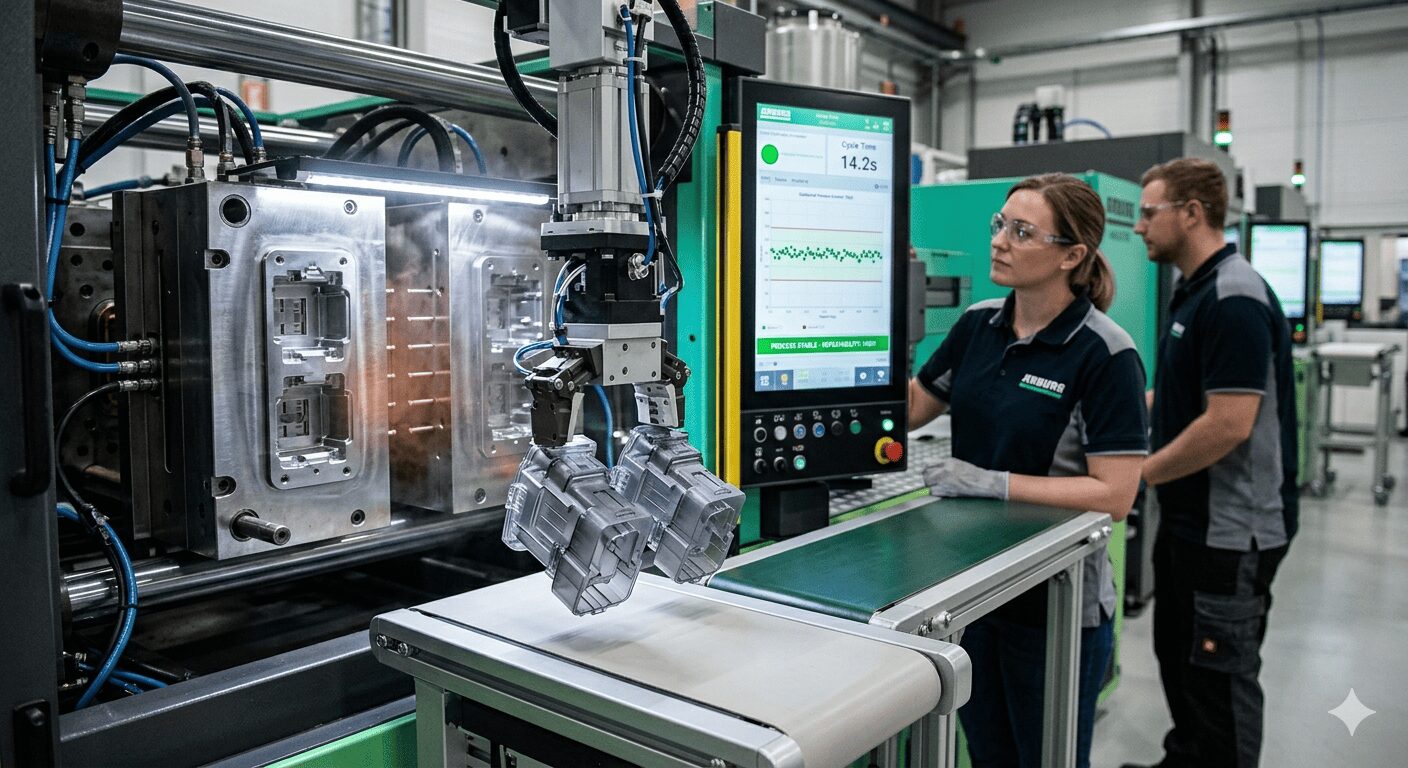
A part that measures perfectly on Monday but drifts out of spec by Thursday is not a quality issue alone. It is a production control issue, and it usually starts earlier than most teams expect. When manufacturers ask how to improve part repeatability, the answer is rarely a single machine setting. Repeatability is built across tooling, resin control, machine capability, process discipline, and inspection methods.
In injection moulding, repeatability means producing the same part geometry, appearance, and performance from shot to shot, shift to shift, and run to run. For OEMs, product developers, and procurement teams, that consistency affects far more than scrap rates. It drives assembly fit, warranty exposure, launch timing, and long-term unit cost.
How to improve part repeatability starts with the mould
If the tool is unstable, the process will be unstable. Many repeatability problems that show up on the production floor are rooted in mould design decisions made much earlier. Gate location, runner balance, cooling circuit layout, venting, steel selection, ejection design, and parting line control all influence whether the cavity fills and cools the same way every cycle.
Cooling deserves special attention because it is one of the most common reasons for dimensional variation. Uneven mould temperature creates uneven shrinkage, and uneven shrinkage creates drifting dimensions. A mold may still produce acceptable parts, but not repeatable ones. The difference matters when tolerances tighten or the part must mate with other components.
Wear is the second mould-related factor that gets underestimated. A tool can validate well and still lose repeatability over time if shut-offs erode, vents clog, slides begin to stick, or parting surfaces degrade. Preventive maintenance is not separate from quality control. It is one of the main ways repeatability is protected over the life of the program.
That is why in-house tooling control changes the outcome. When mould design, mould build, mould modification, and mould maintenance are managed under one roof, corrections happen faster, and root causes are easier to isolate.
Process stability matters more than chasing perfect settings
A common mistake is treating setup as a one-time event. Teams may find a recipe that runs well during sampling, then assume those settings will carry the part forever. In reality, repeatability depends less on finding a perfect number and more on defining a stable processing window.
That window should account for melt temperature, mould temperature, injection speed, fill pressure, holding pressure, screw recovery, cooling time, and clamp performance. The goal is not to lock every variable at a fixed value regardless of conditions. The goal is to understand which parameters are truly critical and how much variation the process can tolerate before the part moves.
Scientific molding methods help here because they separate cause from habit. Instead of relying on operator preference, the process is built around material behaviour, cavity fill response, pressure transfer, and shrink performance. This creates a documented and repeatable approach that can survive shift changes, lot changes, and production restarts.
There is a trade-off, though. A very tight process window can improve consistency but reduce flexibility if incoming material or ambient conditions shift. A wider window may keep output moving but increase dimensional spread. The right balance depends on part function, tolerance stack-up, and end-use risk.
Material handling is often the hidden source of variation
A mould and machine can be fully capable and still produce inconsistent parts if the resin is not handled correctly. Moisture variation, inconsistent regrind ratios, poor drying control, lot-to-lot material shifts, and contamination all affect part repeatability.
Hygroscopic materials are especially unforgiving. If moisture content drifts, dimensions and cosmetic quality can drift with it. In filled materials, resin handling becomes even more sensitive because filler distribution affects shrinkage and stiffness. What looks like a moulding issue may actually be a material preparation issue.
Repeatability improves when resin management is standardised from receiving through production. That means clear material identification, documented drying conditions, controlled residence time, consistent regrind practices, and verification that the machine is actually processing the material state assumed in the setup sheet.
Procurement teams sometimes focus heavily on resin price while underestimating consistency between suppliers or lots. Lower-cost material can be the right decision, but only if it performs predictably in the process. If it causes recurring setup drift, dimensional variation, or extra inspection, the savings disappear quickly.
Machine capability has to match the part and the tool
Not every moulding machine is equally suited for every job. Shot size, screw design, clamp tonnage, platen rigidity, controller accuracy, and hydraulic or electric response all affect repeatability. A part may run on multiple presses, but that does not mean it will repeat the same way on all of them.
This is especially true for tight-tolerance components, cosmetic surfaces, and engineered resins. Running a small shot in an oversized barrel, for example, can create residence time issues and material degradation. Running near the edge of the clamp capacity can introduce flash variation. An underperforming temperature control unit can shift the entire process without obvious alarms.
The practical answer is to match the machine, auxiliary equipment, and mould as a system. When that system is validated properly, production transfer becomes less risky, and repeatability improves across longer runs.
Measurement systems must be as repeatable as the parts
Some part repeatability problems are not production problems at all. They are measurement problems. If gages are inconsistent, if measurement methods vary by inspector, or if the part is checked before it stabilises dimensionally, data will suggest variation that is not truly there.
This is why inspection planning has to be part of process planning. Teams should agree on where dimensions are taken, when they are taken after moulding, under what environmental conditions, and with what equipment. Gage repeatability and reproducibility studies are not just for audits. They prevent false troubleshooting and help production teams respond to the real issue faster.
For parts with critical fit or sealing function, dimensional checks alone may not be enough. Functional testing often reveals repeatability issues earlier than visual or single-point measurement. A part can be technically in tolerance and still fail in assembly if the variation occurs in a way the print does not capture well.
How to improve part repeatability across production runs
The hardest repeatability challenge is not usually within one short run. It is maintaining the same result over months or years, often across maintenance events, operator changes, and demand fluctuations. Long-term repeatability depends on documentation, traceability, and disciplined change control.
Setup sheets should record more than machine settings. They should capture the validated processing window, material conditions, startup sequence, first-piece acceptance criteria, and known sensitivities. If a mould has a cavity that tends to vent poorly or a part feature that responds strongly to hold pressure, that knowledge must be documented, not left to memory.
Change control matters just as much. Switching resin suppliers, adjusting a gate, polishing a cavity, replacing a water line, changing a robot grip, or modifying packaging can all affect repeatability. None of those changes is necessarily bad. The problem is when they happen without revalidation, proportional to the risk.
This is where an integrated manufacturing partner has an advantage. When design support, tooling, moulding, finishing, quality, and logistics are connected, there are fewer handoff gaps where variation gets introduced or missed.
What strong repeatability looks like in practice
Repeatability is not just about hitting print dimensions at inspection. It shows up in predictable cycle times, stable assembly performance, lower sorting activity, fewer customer complaints, and easier production planning. It also makes cost control more realistic because scrap, downtime, and emergency adjustments stop distorting the true cost of the part.
In practice, the best results come from treating repeatability as a system objective rather than a press-side correction. Tooling must be designed for stable processing. Materials must be controlled with discipline. Machines must be properly matched and maintained. Quality methods must produce trustworthy data. And every change must be assessed for its effect on the validated process.
For companies scaling a new product or trying to stabilise an existing one, speed still matters. But speed without control usually creates another round of revisions later. Glasfil approaches repeatability the way high-volume manufacturing should be approached – by controlling the variables in-house, reducing delays between diagnosis and correction, and building production around what the part needs to do consistently.
If your parts only look good during sampling, the process is not ready. The real target is simpler and harder at the same time: a part that comes out right again tomorrow, next month, and after the next production transfer.
Contact us to learn how we can support your next project.