A frosted skincare jar can look premium on the shelf and still fail in the supply chain if its decoration scratches, peels, or shifts during filling. Integrated packaging engineers design labeless cosmetic packaging to solve that exact production problem. Rather than applying a pressure-sensitive label after molding, manufacturers build the product identity directly into the component through material, surface, color, texture, or integrated decoration.
For cosmetic brands, the appeal is clear: cleaner visuals, greater durability, and fewer post-moulding handling steps. For product developers and procurement teams, however, the decision reaches much further. Label-free designs directly affect mould construction, resin choice, cycle time, quality inspection, artwork approvals, and how teams present mandatory product information.
What Labeless Cosmetic Packaging Really Means
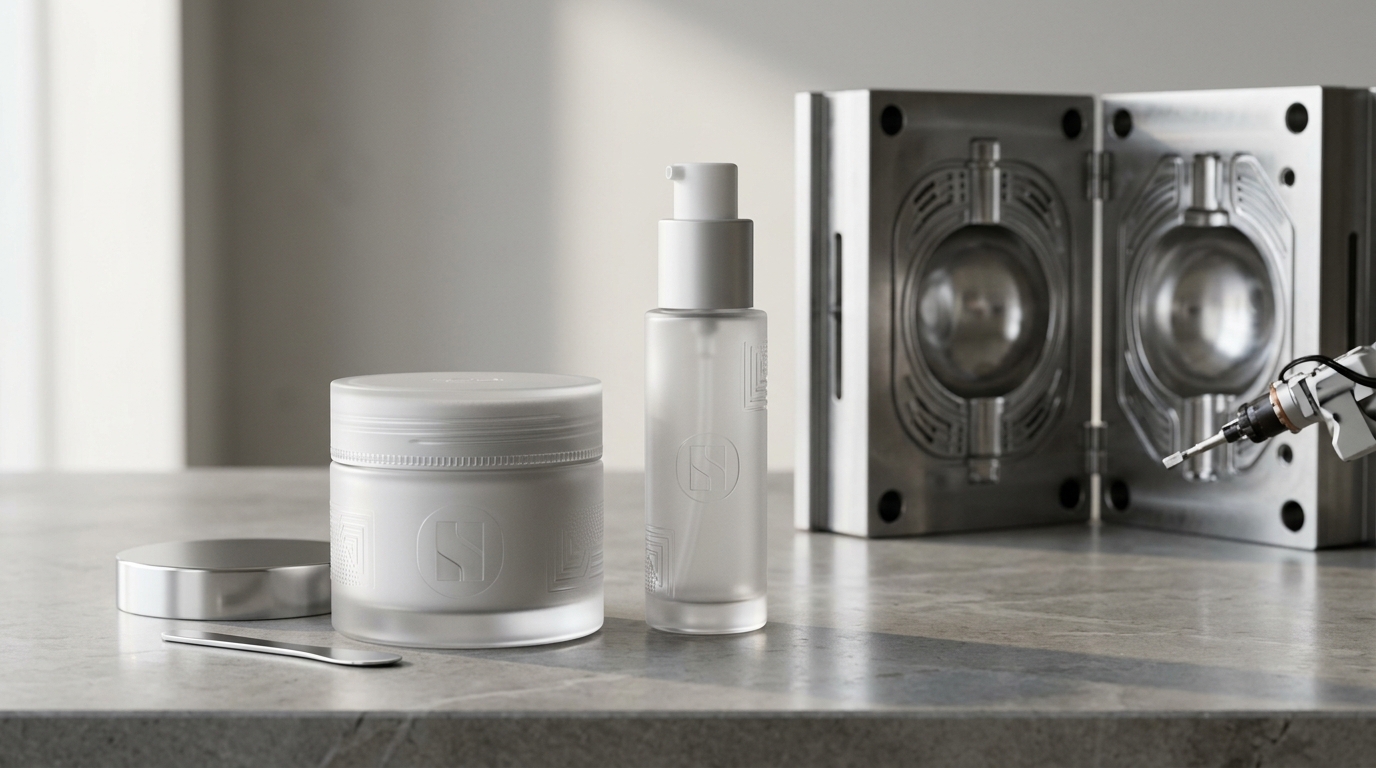
Labeless cosmetic packaging does not always mean a package with no printed information. Usually, it means the primary container does not rely on a conventional adhesive label as its main visual feature. A bottle, compact, cap, jar, or dispenser may carry its appearance through a molded logo, a color-matched body, a tactile pattern, in-mold decoration, or direct printing.
The distinction matters because cosmetic packs still need space for brand communication, product identification, ingredient information, warnings, batch coding, and market-specific requirements. Depending on the product and destination market, teams may place this information on a carton, outer wrap, insert, secondary component, or a dedicated print area on the pack. Manufacturers should make production decisions with the complete packaging system in view, not from the container’s standalone appearance.
A minimal bottle does not automatically simplify manufacturing. In some cases, removing a label simplifies final assembly. In others, it transfers complexity upstream into the mold, the material specification, and the finishing process. Production volume, SKU strategy, brand requirements, and the physical conditions the pack will face determine the right solution.
Why Cosmetic Brands Are Moving Away From Labels
Adhesive labels provide flexibility and cost-effectiveness for short runs, changing formulas, and frequent artwork updates. They can also carry substantial regulatory information without enlarging the molded component. However, labels introduce visible edges, alignment risks, adhesive performance concerns, and an extra application operation.
For prestige skincare, personal care, and refill-oriented concepts, a label-free direction creates a more permanent product identity. A debossed logo does not wrinkle in humidity. A textured grip forms an integral part of the component rather than an added layer. Color molded directly into the resin remains permanent, although resin grade, wall thickness, pigment control, and tool surface finish still dictate its final appearance.
The commercial advantage lies in consistency. When production delivers a container with its essential visual characteristics already formed, fewer opportunities exist for downstream decoration misalignment. This improves repeatability at scale, provided engineers establish tooling and process controls correctly from the start.
The Design Choices That Determine Production Results
Molded branding and surface texture
Raised and recessed logos, patterns, ribs, and tactile surfaces are effective ways to create recognition without an applied label. They are especially suitable for caps, jars, compact cases, and closures where the feature can be designed into the cavity or core.
The trade-off is geometric. Fine text, sharp corners, and overly deep details may not fill consistently, may trap air, or may make ejection more difficult. Texture can also reveal flow lines, gloss differences, or material variation if it is not selected carefully. A moldability review should confirm draft angles, wall transitions, gate position, venting, and ejection before the aesthetic direction is approved.
Color and resin selection
A color-forward pack can be the simplest route to a labeless appearance, but color should not be treated as a purely visual decision. Cosmetic packaging may be exposed to oils, alcohols, fragrances, moisture, heat, ultraviolet light, and repeated consumer handling. The resin must match the formula, expected use environment, stiffness requirements, and target finish.
Polypropylene, PET, ABS, and other plastics each offer different processing and appearance characteristics. A high-gloss look may require a different material approach than a soft-touch, matte, translucent, or frosted effect. Color consistency also requires disciplined control of masterbatch, regrind policy, drying conditions where applicable, and production parameters.
Direct printing and in-mold decoration
Direct printing can preserve the clean look of a label-free container while still providing graphics or information. It works well when artwork is stable and the printing surface is controlled. However, print adhesion, abrasion resistance, and chemical resistance must be tested against the actual product and handling conditions.
In-mold labels and in-mold decoration provide another route. The decorative element is integrated during molding, creating a highly controlled result with no separate adhesive-label application after the part is produced. This approach can support detailed graphics, but it requires precise mold design, specialized automation or handling, qualified decoration materials, and rigorous startup validation. It is generally more suitable when volumes justify the tooling and process investment.
Tooling Control Is the Difference Between a Concept and a Repeatable Part
Minimal cosmetic packaging leaves little room to hide production variation. A small sink mark beside an embossed logo, a mismatched parting line on a polished cap, or inconsistent gloss across a jar can affect the perceived value of the final product. The mold must be engineered for appearance as well as dimensional function.
That starts with part design. Wall thickness should be as consistent as possible to reduce shrinkage variation and visual defects. Gates should be positioned where flow marks are least visible. Cooling must be balanced to support stable cycle times and reduce warpage. Ejection marks need to be placed where they will not disrupt a visible branding surface.
Tool maintenance also has a direct effect on packaging quality. Textures wear, vents become restricted, and polished surfaces can lose their appearance over repeated cycles. When mold modification and maintenance are managed in-house, engineering teams can respond faster to pilot-run findings, artwork adjustments, fit changes, or process issues before they become costly production delays.
Validate the Whole Pack, Not Just the Empty Component
An empty cosmetic jar may pass a visual review and still underperform once it enters the filling line. Testing should reflect the real product journey: filling, capping, transport, storage, retailer handling, and consumer use. Compatibility testing is particularly important for formulas containing oils, solvents, active ingredients, or fragrances that can affect plastics, coatings, and printed finishes.
Quality checks should cover dimensions, weight, color, surface appearance, closure fit, leakage performance where relevant, and decoration durability. For components with an integrated logo or texture, inspection criteria should define what is acceptable before production begins. Vague phrases such as “premium finish” create disputes. Measurable reference samples, approved color standards, and clearly documented defect limits create control.
This is also where a contract manufacturer should challenge assumptions. A deep matte texture may look excellent in a prototype but retain residue during consumer use. A dark color may show scratches more readily than expected. A translucent wall may expose internal components or formula variation. Practical engineering feedback protects both the brand intent and the production schedule.
When Labeless Packaging Is the Right Commercial Choice
Labeless cosmetic packaging is strongest when the brand has a stable visual system, expects repeat production, and wants durability that supports a premium or highly functional product position. It can be particularly effective for signature jars, caps, dispensers, and reusable packaging where the component itself is meant to communicate quality.
It may be less suitable for a brand with many small seasonal runs, frequent compliance changes, or highly variable artwork. In those cases, conventional labels or cartons may provide more flexibility at a lower initial cost. A hybrid approach is often the practical answer: use molded identity and material-led design for permanence, then retain a discreet print or secondary packaging solution for changing product information.
For teams moving from concept to production, the key question is not whether a label can be removed. It is whether the desired appearance can be engineered into a component that fills reliably, survives use, meets information requirements, and can be reproduced at the required volume. Glasfil approaches that question through integrated mold design, injection molding, finishing, and quality control, so production risks can be addressed before they reach the line.
Start with the product formula, the required information, and the intended production volume, then let those facts shape the packaging design. A clean cosmetic pack earns its value when its appearance is not merely minimal, but engineered to remain consistent from the first molded part to the next production run.
Ready to scale your next eco-friendly cosmetic line? Contact us today with your 3D models and target specs to get a validated production plan.