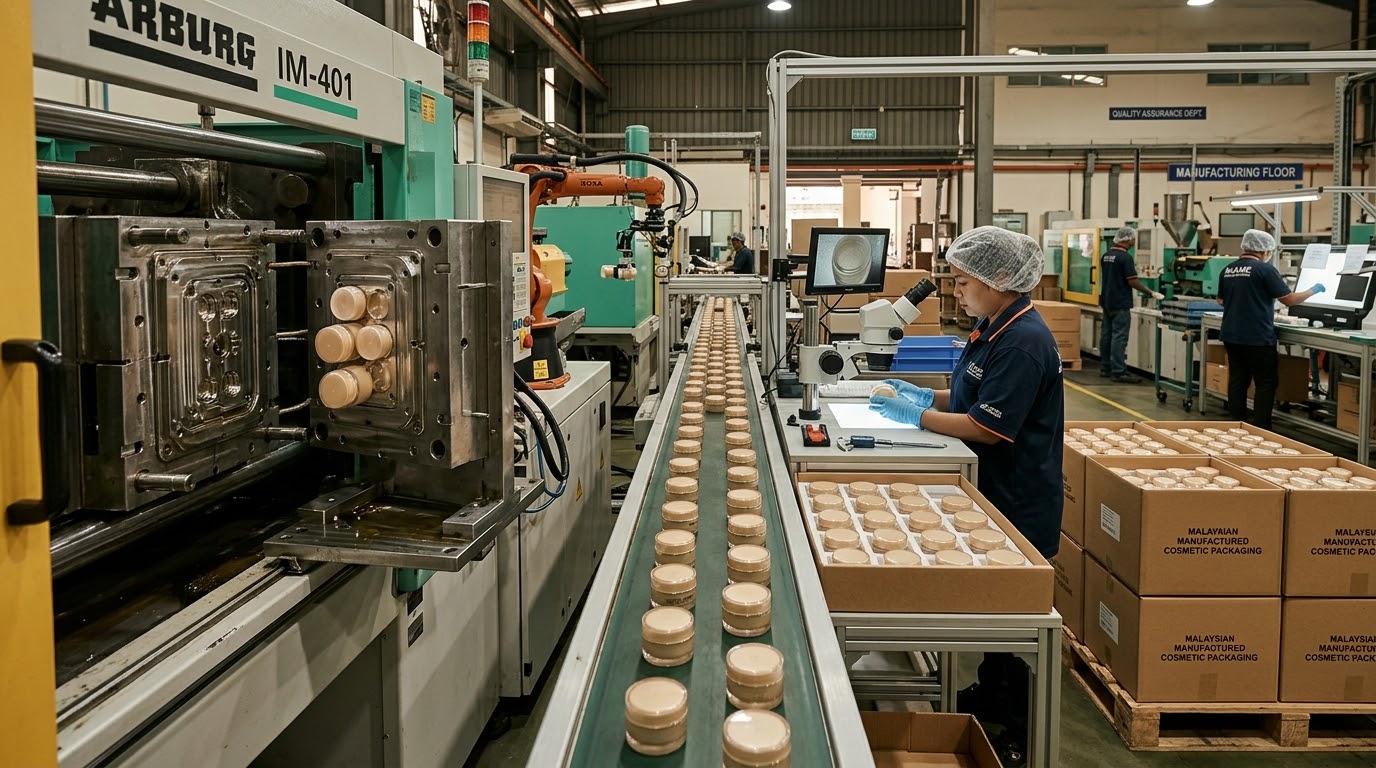
A launch date can be lost long before production begins. It is often lost when a cosmetic packaging design reaches tooling with unclear tolerances, an unsuitable resin, or a decoration requirement that was never tested against the part geometry. For brands seeking cosmetic packaging fast turnaround Malaysia, the real requirement is not simply a supplier that promises speed. It is a manufacturing partner that controls the decisions affecting speed from design review through finished parts.
For custom plastic cosmetic components, fast turnaround depends on engineering discipline. The mold must be designed for the required volume, material flow, surface appearance, assembly fit, and repeatability. Production must then be supported by controlled molding, inspection, finishing coordination, and packing that protects cosmetic-grade presentation. When these functions are fragmented across several vendors, every design change creates delay and accountability becomes unclear.
Why cosmetic packaging timelines slip
Cosmetic packaging looks simple from the shelf, but its production requirements are exacting. A cap must thread smoothly and close consistently. A compact must open with the intended feel. A jar and lid must align without visible mismatch. A closure may need to work with an insert, liner, pump, or bottle supplied by another manufacturer. Small dimensional variation can become a visible quality problem when glossy surfaces, metallic decoration, or tight color matching are involved.
The most common schedule risk is treating tooling as a purchasing step rather than an engineering process. A low initial mold quote may not account for the time needed to revise gate placement, correct shrinkage, improve ejection, or resolve sink marks on a highly visible surface. If the mold maker, molder, and finishing provider are separate businesses, each correction adds transport, communication, and approval time.
Material selection can create another delay. Polypropylene is commonly selected for its chemical resistance and practical cost, while ABS, SAN, PET-related materials, and specialty resins may be considered for different appearance, rigidity, or compatibility needs. The right choice depends on the formula, component function, decoration method, and target price. A resin that performs well in a standard consumer product may not be appropriate for a component exposed to oils, solvents, fragrance, or repeated opening cycles.
Speed comes from resolving these questions early, not from skipping them.
Cosmetic packaging fast turnaround in Malaysia starts with tooling control
An integrated manufacturer can shorten the critical path because design refinement and mold modification stay close to the production floor. When a trial reveals a dimensional issue or cosmetic defect, the engineering team can assess the part, modify the tool, and run another sample without waiting for an outside toolroom to accept the work.
That control matters particularly for packaging with multiple mating parts. Consider a cream jar with a threaded lid and inner cover, or a compact case with a hinge, clasp, mirror recess, and refill tray. Each part may be moldable on its own, yet the product fails if the assembled unit does not meet fit, function, and appearance expectations. A fast program needs assembly thinking from the start.
At Glasfil, design, mold fabrication, modification capability, injection molding, secondary processing, packing, and shipping are managed in-house. This model reduces handoffs and gives project teams a clearer route from concept to production. With 19 machines up to 560-ton capacity across two manufacturing plants, the company can support custom components that require both technical attention and production planning. Its stated eight-week completion timeline is built around integrated execution, not a shortcut around tooling validation.
The exact timeline still depends on part complexity, number of cavities, material availability, finish requirements, and the number of approval cycles. A single molded cap using an established resin can move differently from a premium compact with several components and a high-gloss exterior surface. The point is to identify the real production path early enough to manage it.
Design choices that protect speed and product appearance
The best time to protect a launch schedule is before the first steel is cut. A production-focused design review should examine draft angles, wall thickness, ribs, undercuts, gate location, parting lines, and ejection points. These decisions are not only technical details. They determine whether the component releases reliably from the mold and whether visible areas stay clean.
A few trade-offs are especially relevant in cosmetic packaging.
High-gloss surfaces can elevate perceived product value, but they also reveal flow lines, weld lines, scratches, and handling marks more readily than textured surfaces. Fine textures can help conceal minor visual variation, though they may not suit every premium brand direction. Deep colors and metallic effects may require closer process control because color variation is more noticeable between production lots.
Thin walls can reduce material use and cycle time, but they can also increase the risk of warpage, short shots, and inconsistent filling. Thick sections may improve rigidity in some areas, yet they can produce sink marks or longer cooling times. A balanced wall design usually delivers more predictable output than an aggressive material-reduction target.
Complex closure features may create a more distinctive user experience, but they can require slides, lifters, unscrewing mechanisms, or tighter mold tolerances. These features are achievable when justified by the product, but they affect tooling cost, maintenance needs, and timeline. A manufacturer should explain those effects before the design is finalized.
Build the approval process around production reality
Fast turnaround does not mean receiving a first sample and immediately authorizing full production. It means making each approval stage purposeful. The initial sample should confirm form, assembly, and visible appearance. The next stage should verify that the chosen material and process settings produce repeatable parts. Before mass production, the team should agree on the acceptable standard for color, gloss, flash, gate vestige, fit, and packaging protection.
For cosmetic components, reference samples are useful because terms such as “premium finish” or “clean appearance” are subjective. A signed reference part gives procurement, engineering, quality teams, and the manufacturer a common standard. It also reduces late-stage disagreement when production output is evaluated.
Packaging for shipment deserves the same attention. Cosmetic components can be scratched, compressed, or contaminated in transit even when they leave the molding line in acceptable condition. Tray design, polybagging, carton quantity, separators, and labeling should match the component’s surface sensitivity and the customer’s downstream assembly process. An attractive part that arrives damaged is not a successful production result.
What to ask before selecting a fast-turnaround partner
Procurement teams should look beyond quoted lead time. The more useful question is where the supplier controls the work and where it depends on third parties. Ask whether mold design and fabrication are in-house, how modifications are handled after trials, which quality checks occur during production, and how the supplier manages finishing and packing requirements.
It is also worth asking for a clear view of the timeline: design confirmation, tooling manufacture, first trial, sample approval, modification allowance, production run, and shipment preparation. A credible supplier will identify dependencies instead of presenting every project as identical.
For brands supplying their own bottle, pump, applicator, or formula-contact component, provide mating samples and functional requirements as early as possible. This prevents a common problem: a molded part meets its individual drawing but does not perform correctly in the final pack. The fastest route to launch is a specification that reflects the assembled product, not only one component.
A faster launch is built before the mold runs
Malaysia offers a capable base for export-oriented plastic manufacturing, but location alone does not create a faster packaging program. The difference comes from how closely engineering, tooling, molding, quality, and fulfillment are connected. When one team can act on trial results quickly, protect critical dimensions, and prepare parts for the customer’s assembly line, schedule risk becomes manageable rather than mysterious.
Bring the design intent, target volume, material expectations, finish standard, and mating components into the first technical discussion. That gives the manufacturer the information needed to recommend a realistic tooling strategy and production plan. A well-prepared start is often the most valuable day in the entire turnaround.
Ready to upgrade your cosmetic packaging? Contact us today to evaluate your design and run a trial with sustainable materials.