A molding cell can produce a technically sound part and still lose money through inconsistent handling, avoidable downtime, or labor-intensive secondary work. Molding automation addresses those losses by controlling the repeatable tasks around the press: part removal, inspection, assembly, packaging, material movement, and production data capture. The goal is not automation for its own sake. It is a more predictable operation that protects part quality while supporting the volume, cost, and delivery requirements of the program.
For OEMs, product developers, and procurement teams, the right question is not whether a process can be automated. It is whether automation will solve a measurable production constraint without adding unnecessary complexity. The answer depends on part geometry, annual volume, cycle time, quality risk, labor availability, and the downstream operations required before shipment.
Where Molding Automation Creates Real Value
Injection molding is already a highly repeatable process, but the actions immediately before and after molding often introduce variation. A part that remains in the mold too long can deform. A part handled inconsistently can be scratched, contaminated, or mixed with another production lot. A manual assembly step can become the limiting factor even when the molding machine has available capacity.
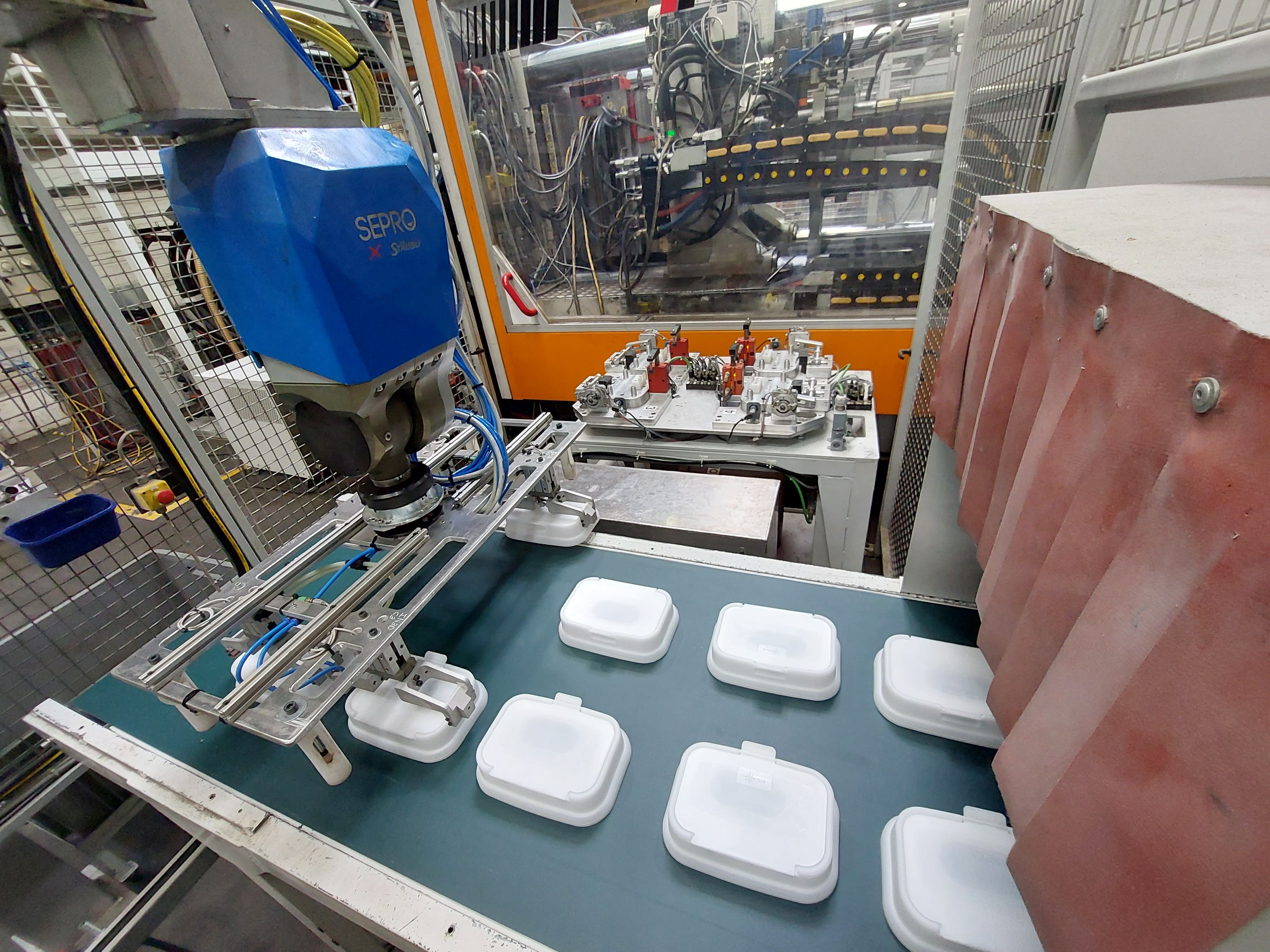
Automation is most valuable where it removes this variation. A robot or end-of-arm tool can remove a part at the same point in every cycle, place it in a fixture, orient it for inspection, and transfer accepted components to the next operation. This supports stable cycle times and reduces the dependence on manual handling for high-volume work.
The business case becomes stronger when one automated action supports several outcomes. For example, a takeout robot may improve part handling, protect operator safety, maintain cavity separation, and prepare components for automated packing. A vision system may verify a feature, confirm color or insert presence, and create a traceable quality record. The objective is to build a cell that performs useful work at every handoff.
Start With the Production Constraint, Not the Equipment
A common mistake is selecting automation equipment before defining the production problem. A six-axis robot may be appropriate for a complex in-mold assembly or flexible secondary operation, but it can be excessive for a simple pick-and-place task. Conversely, a basic sprue picker may not provide the positioning accuracy needed for delicate cosmetic parts or insert loading.
The first step is to map the complete production flow, from resin preparation through finished-goods packing. Review the molding cycle, operator tasks, inspection points, reject handling, assembly requirements, labeling, and palletizing. This reveals where time, quality risk, or cost accumulates.
A practical assessment should establish five points: expected production volume, required cycle time, part handling requirements, quality-critical features, and the number of secondary operations. It should also account for product changes. A dedicated automation cell can be highly efficient for a stable, long-running program. For lower-volume or evolving products, flexible automation may deliver a better return because it can be reconfigured for multiple part families.
The Core Elements of an Automated Molding Cell
The molding machine remains the center of the cell, but its performance depends on the systems connected to it. Material drying and feeding must supply consistent resin conditions. The mold must release parts reliably. Automation must operate within the available cycle window, and downstream stations must keep pace with output.
Part removal is typically the first automation decision. Top-entry Cartesian robots are often an efficient choice for straightforward takeout, sprue removal, and placement. Side-entry systems can support very fast cycles. Six-axis robots provide greater flexibility where parts require complex orientation, loading into fixtures, or movement between multiple operations.
End-of-arm tooling deserves the same engineering attention as the robot itself. The tool must grip the part without marking cosmetic surfaces, deforming thin walls, or interfering with critical features. Vacuum cups, mechanical grippers, magnetic systems for overmolded metal elements, and custom nests all have different advantages. The right design accounts for mold opening, cooling time, part stiffness, runner configuration, and safe recovery if a part does not release correctly.
Downstream automation may include degating, camera inspection, leak testing, insert assembly, ultrasonic welding, printing, labeling, counting, bagging, or case packing. Not every program needs all of these steps integrated into one cell. In some cases, separating operations improves maintenance access and lets production continue when a secondary station requires adjustment. In others, full integration minimizes handling and prevents work-in-process buildup.
Quality Control Must Be Built Into the Process
Automation should strengthen quality control, not merely accelerate output. A fast cell that produces undetected defects is expensive. The most effective systems define what must be checked, how defects are rejected, and how quality data is connected to the manufacturing lot.
For dimensional or cosmetic features, automated vision inspection can identify short shots, flash, color variation, missing inserts, incorrect orientation, and surface defects. For components used in electrical, utility, automotive, or fluid-handling applications, the cell may also require functional testing such as continuity checks, pressure tests, or leak detection.
Inspection requirements should be proportionate to risk. Checking every non-critical cosmetic detail on every low-volume part may add cost without meaningful benefit. On the other hand, a water meter component with a sealing surface or an electrical housing with a critical insert may justify 100% verification. The inspection plan should reflect the component’s function, the consequences of failure, and the proven capability of the molding process.
Traceability is equally important for many industrial programs. Automated marking, barcode application, cavity tracking, and production data collection make it easier to investigate a quality issue and contain affected material. This is especially valuable when components are shipped across multiple plants, markets, or assembly locations.
Designing Parts and Tooling for Automation
The most efficient automation decision is often made before the mold is built. Part geometry, gate location, ejection method, and draft all influence how reliably a robot can remove and position a component. A part that nests tightly in the mold or distorts during ejection may need tooling revisions before automation can perform consistently.
Design for automation does not mean compromising the product. It means considering practical production details early. Parts may need a stable gripping surface, a defined orientation feature, sufficient rigidity at the point of handling, or a fixture-friendly datum. Mold tooling may require sensors to confirm part ejection, cavity separation logic, or provisions for insert loading.
This is where an integrated manufacturer has a clear advantage. When mold design, fabrication, molding, quality assurance, and modification capability are managed in-house, engineers can resolve issues across the full process rather than treating each step as a separate supplier responsibility. Glasfil applies this approach from tooling development through production, secondary processing, packing, and shipment.
When Automation Is Not the Best First Move
Automation is not automatically the lowest-cost option. The capital investment, integration time, programming, maintenance, spare parts, validation, and operator training must be justified by the expected production benefit. For prototype work, short runs, highly variable product mixes, or parts that are still changing, skilled manual operations may be more practical.
The transition point is different for every program. A simple part with a very short cycle and continuous demand may justify automation quickly. A complex low-volume component may be better served by a semi-automated fixture that improves repeatability while retaining operator flexibility. The right solution can range from a basic takeout robot to a fully integrated cell with inspection, assembly, and packaging.
Maintenance planning also matters. Automated cells require preventive maintenance for grippers, sensors, actuators, conveyors, safety systems, and software. A cell should be designed so operators can safely access common service points and recover from predictable faults without extended downtime. Reliability is not only about selecting quality equipment. It is about making the entire system serviceable in a real production environment.
A Better Standard for Molding Automation
The strongest molding automation projects begin with a production target: stable cycle time, lower handling damage, verified assembly, reduced labor exposure, improved traceability, or faster throughput. Equipment choices then follow the requirement rather than the other way around.
Before committing to a system, ask whether the mold, part design, quality plan, and downstream workflow are ready to support it. When those elements are engineered together, automation becomes a practical manufacturing asset that keeps parts moving, quality visible, and delivery commitments achievable.
Contact us to discuss your project, request a quotation, or arrange a technical consultation. Our team will help you determine the most cost-effective and reliable way to manufacture your part.