A resin that performs well in a prototype can fail the production program long before a molded part reaches the market. It may discolor after sterilization, crack under a cleaning chemical, create molding variation, or arrive without the documentation needed for a controlled supply chain. Medical grade resin selection must therefore begin with the finished part’s real operating conditions, not with a familiar polymer name or a low per-pound material price.
For product developers, engineers, and procurement teams, the objective is not simply to identify a resin labeled for medical use. The objective is to choose a material and production approach that teams can qualify, mold repeatedly, document appropriately, and supply consistently through the life of the program.
Medical Grade Resin Selection Starts With the Application
A resin supplier may designate a particular grade as suitable for certain healthcare applications, supporting it with controlled formulation, biocompatibility information, or change-notification commitments. That designation does not automatically make every finished component suitable for every medical device.
The right starting point is a detailed application definition. Is the part a single-use fluid-path component, a reusable instrument housing, a diagnostic cartridge, a drug-delivery component, or an external enclosure? Will it contact skin, tissue, medication, or bodily fluids? How long will contact last? Does the device require a clear window, a precision snap fit, chemical resistance, radio-frequency transparency, or repeated actuation?
Those answers narrow the material field quickly. A transparent diagnostic housing may point toward polycarbonate, cyclic olefin polymers, or acrylic-based options depending on chemical exposure and optical requirements. A component facing repeated steam sterilization may require high-temperature materials such as PPSU, PSU, PEEK, or a carefully validated alternative. A flexible seal or overmold introduces a different set of decisions around elastomers, adhesion, compression set, and extractables.
Engineers and designers should write application requirements before beginning material sourcing. This prevents a common and expensive sequence: tooling a part around a readily available resin, then discovering that sterilization, testing, or regulatory review requires a different grade with different shrinkage and processing behavior.
Separate Material Qualification From Device Compliance
Material documentation matters, but teams should interpret it accurately. A resin may have test data associated with ISO 10993 or USP Class VI, but defined samples and specific test conditions produce those results. Pigments, additives, mold release agents, processing conditions, cleaning methods, secondary operations, packaging, and sterilization can cause the final molded device to behave differently.
For that reason, material selection and finished-device evaluation are connected but separate workstreams. The resin supplier’s documentation can support the risk assessment and establish a starting point. The device manufacturer remains responsible for determining what verification and validation the final product requires.
This distinction also affects color decisions. A natural resin grade may have supporting information, while a custom color concentrate changes the final formulation. The same caution applies to recycled content, regrind, lubricants, and substitute additives. In medical applications, teams should review every additional material input for its impact on performance, traceability, and compliance strategy.
Ask for the Right Supply-Chain Controls
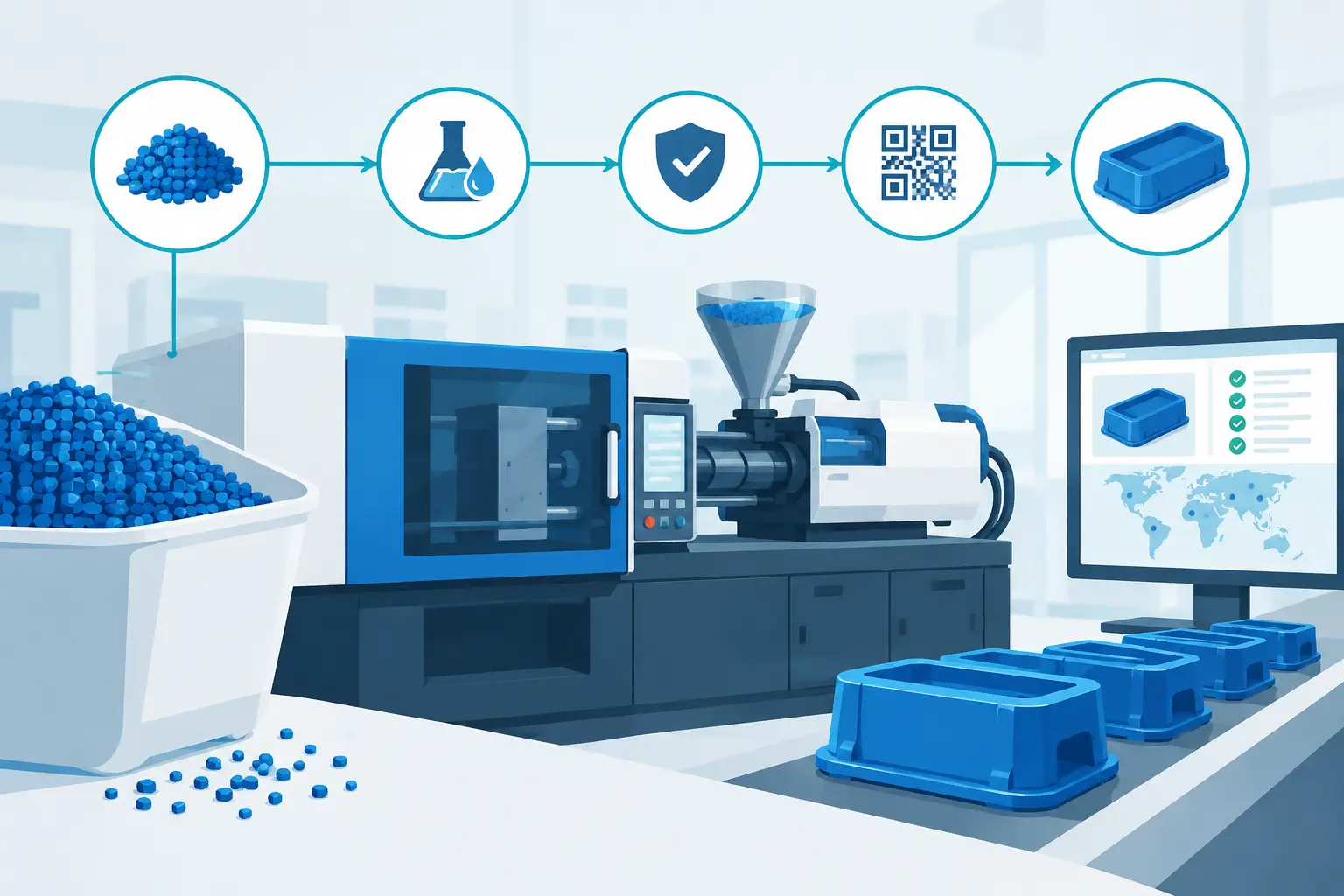
A production-ready resin decision includes more than a technical data sheet. Buyers should establish which documents, commitments, and controls the program requires. Depending on device risk and market requirements, that may include lot traceability, certificates of analysis or conformance, a controlled manufacturing location, notification of formulation changes, long-term availability expectations, and retention of production records.
A practical trade-off exists here. A highly controlled grade can improve confidence and simplify qualification, but it may carry longer lead times, higher minimum order quantities, or fewer sourcing options. A lower-risk external component may not require the same level of material control as a long-term implantable or fluid-contacting part. The application determines the correct level of control, not a blanket rule.
Match Resin Performance to Sterilization and Chemicals
Sterilization is often the decision point that eliminates otherwise promising materials. Gamma irradiation can cause discoloration, embrittlement, or property changes in certain polymers. Ethylene oxide introduces different considerations, including aeration and residual management at the device level. Steam autoclave cycles place heat and moisture demands on the part, while hydrogen peroxide plasma and other methods require their own compatibility review.
The number of cycles matters as much as the method. A disposable component exposed once has a different requirement than a reusable instrument that teams expect to survive hundreds of cleaning and sterilization cycles. Testing should represent the full intended cycle, including detergents, disinfectants, drying, mechanical loading, and aging where applicable.
Chemical exposure deserves equal attention. Alcohols, lipids, saline solutions, contrast media, cleaning agents, and pharmaceuticals can stress polymers in ways that room-temperature tensile data will not reveal. Polycarbonate, for example, offers useful clarity and impact performance but may need careful review where specific cleaners or stress-cracking conditions are present. A material that is chemically compatible in isolation can still fail when molded-in stress, tight assembly forces, and repeated cleaning combine.
Design for the Resin and the Molding Process
Injection molding is not a neutral step between material selection and finished part performance. The resin’s flow behavior, moisture sensitivity, shrinkage, fiber content, and processing window affect tool design, dimensional capability, appearance, and cycle time.
A high-flow material may fill thin walls more easily, but it can create other trade-offs in strength or stress-crack resistance. Glass-filled materials can improve stiffness and reduce some dimensional movement, yet they may increase tool wear, affect surface finish, and produce directional shrinkage. Highly transparent polymers demand tooling, venting, and process control that protect optical quality. Hygroscopic materials require disciplined drying because excess moisture can degrade properties during molding.
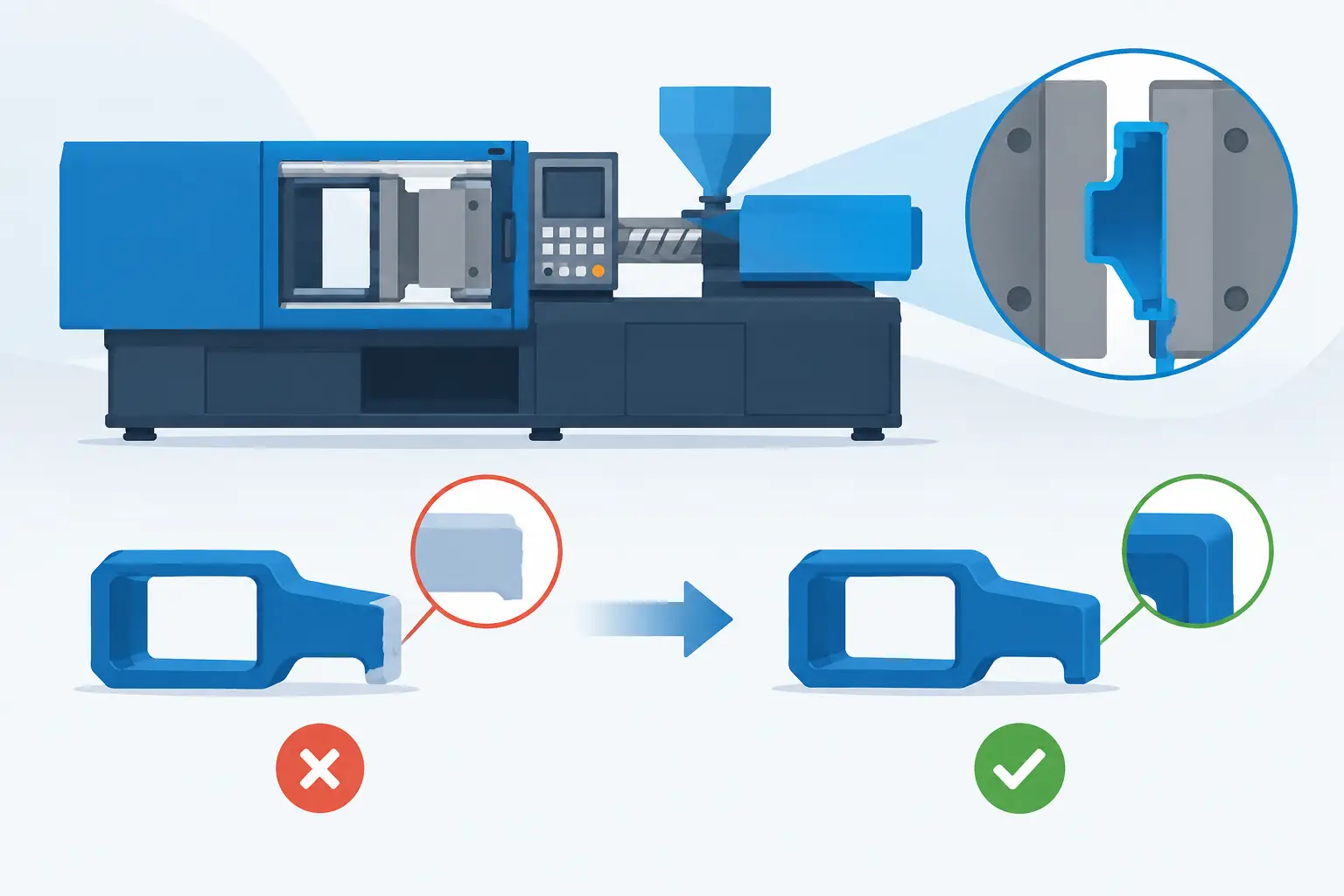
Part geometry should be evaluated alongside the candidate resin. Wall transitions, gate location, rib proportions, weld lines, undercuts, and assembly features all influence real-world results. A resin change after tooling can require gate revisions, cooling changes, revised venting, or rework to accommodate a different shrink rate. Early collaboration between design engineering, material suppliers, and the molder reduces that risk.
Tooling Decisions Affect Validation Speed
Medical programs benefit from tooling designed for controlled repeatability. That means selecting steel, cooling layouts, cavity configuration, and gating based on the required volume, tolerances, resin behavior, and validation plan. A prototype mold may prove geometry, but it does not always represent the thermal control, automation, or cavity-to-cavity consistency needed for production qualification.
In-house mold design, fabrication, modification, and molding create a practical advantage when a project moves from design review into sampling. If the first shots reveal a filling issue, cosmetic defect, or dimensional concern, the team can evaluate the relationship between resin, process settings, and tool condition without waiting on multiple disconnected suppliers. Fast correction is valuable, but controlled documentation of the correction is equally important for a medical program.
Use a Risk-Based Material Down-Selection Process
The most effective approach is to compare candidate resins against a defined set of requirements rather than relying on one headline property. Teams should evaluate at least the following four areas:
- Functional performance, including strength, flexibility, optical needs, wear, and dimensional stability.
- Exposure resistance, including sterilization, cleaning agents, chemicals, temperature, and environmental aging.
- Quality and compliance support, including available test information, traceability, change control, and documentation.
- Manufacturing fit, including moldability, drying requirements, cycle time, scrap risk, availability, and total cost.
This comparison should include molded samples, not only supplier plaques or published data. Test parts made from production-intent material and processed under representative conditions. When the application warrants it, include worst-case conditions such as maximum wall thickness, high residual stress locations, colorants, assembled components, and post-processing steps.
Cost should be assessed across the program, not just at resin purchase. A lower-cost material that needs slow cycles, rejects frequently, requires excessive drying, or creates field-performance risk can be the more expensive choice. Conversely, an engineered resin may cost more per pound while reducing wall thickness, improving yield, or avoiding costly tool changes.
Build the Material Decision Into Production Control
Once a resin is selected, preserve the decision through disciplined production controls. The approved grade, supplier, color system, drying conditions, regrind policy, process window, inspection requirements, and packaging expectations should be defined before repeat production begins. Material substitutions should never be treated as routine purchasing decisions when qualification and device performance depend on the original formulation.
The best material choice is one that works beyond the lab sample. It should support the part’s function, the device’s validation path, the molding process, and the supply chain that will deliver it year after year. Start that work early, while geometry and tooling can still be adjusted. A well-defined resin decision gives every downstream step a more reliable foundation.
Contact us to discuss your project, request a quotation, or arrange a technical consultation. Our team will help you determine the most cost-effective and reliable way to manufacture your part.