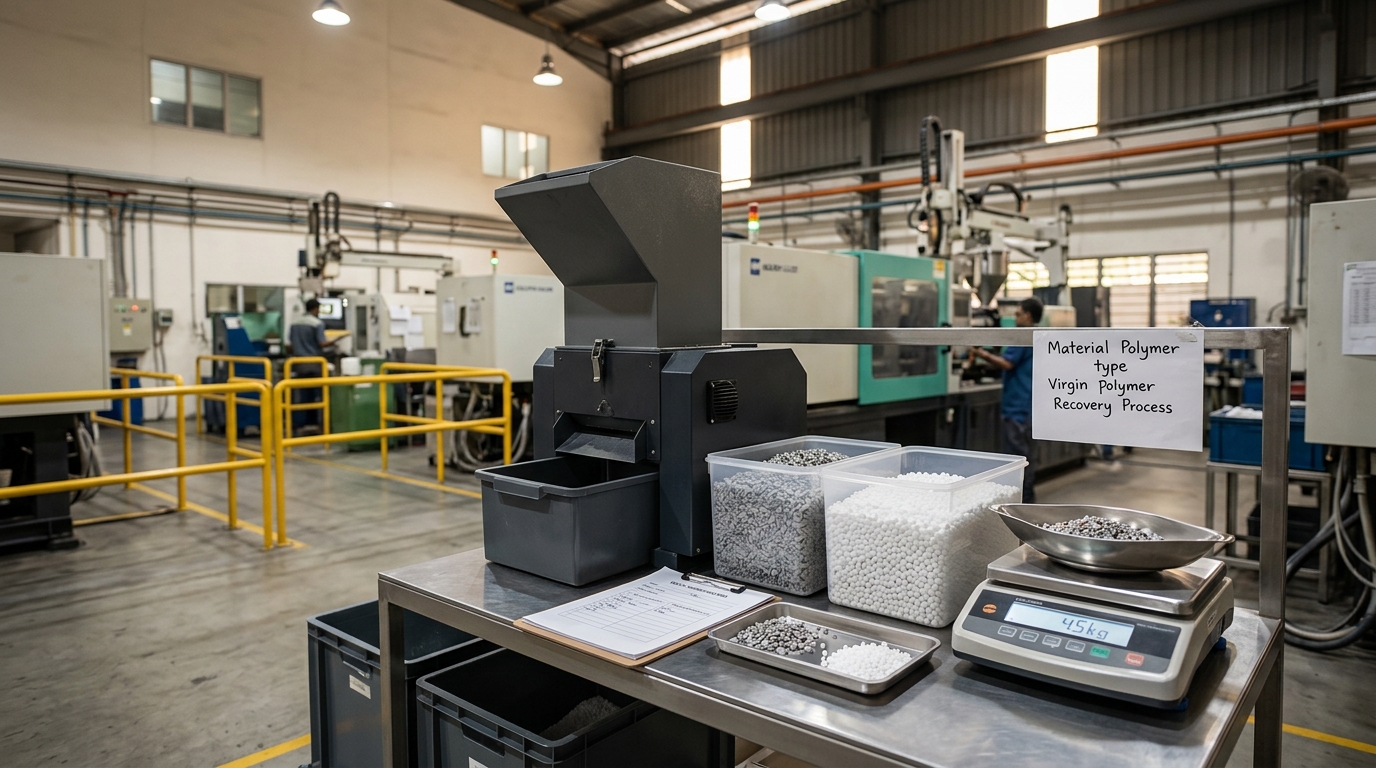
A sustainability target can fail long before the first part leaves the press. A resin may contain recycled content, but if it causes unstable filling, excessive scrap, premature tool wear, or rejected assemblies, the environmental benefit quickly erodes. Sustainable molding is not a material claim applied at the end of development. It is a production discipline that connects part design, resin selection, mold engineering, processing, quality control, and end-of-life planning.
For OEMs, product developers, and procurement teams, the commercial question is straightforward: can a lower-impact part be produced repeatedly at the required quality, cost, and delivery schedule? The answer depends on the application. There is no universal recycled-content percentage or single “green” resin that fits every program. What works for an interior furniture component may not meet the dimensional, electrical, cosmetic, or regulatory requirements of an automotive, utility, or electronic part.
Sustainable Molding Starts With the Part Requirement
The most effective sustainability decisions are made while the part is still being designed. Material use, cycle time, scrap rate, assembly complexity, and service life are all influenced by geometry. A part that uses less resin but warps in production is not an improvement. Neither is a lightweight component that needs extra ribs, inserts, fasteners, or secondary operations to perform its job.
Start by defining the functional requirements that cannot move: mechanical load, impact resistance, heat exposure, chemical contact, flame rating, color consistency, electrical properties, surface finish, dimensional tolerance, and expected product life. These requirements create the engineering boundary for evaluating alternatives.
From there, teams can assess practical changes such as wall-thickness optimization, rib design, draft angles, part consolidation, and gate placement. Reducing unnecessary thickness can lower resin consumption and shorten cooling time. However, wall reduction must be balanced against stiffness, sink marks, filling pressure, and long-term durability. A properly engineered geometry usually delivers more value than simply specifying a different resin grade.
Design for manufacturing also prevents avoidable waste. Uniform walls, adequate draft, realistic tolerances, and features that support consistent ejection reduce the likelihood of distortion, flash, short shots, and handling damage. These are production issues, but they directly affect the material and energy consumed per acceptable part.
Material Selection Requires More Than Recycled Content
Recycled polymers can be a strong option when the feedstock, formulation, and process are controlled. Post-industrial recycled material is often more consistent because its source is known. Post-consumer recycled content can support broader waste-diversion goals, but it may involve greater variation in melt flow, contamination risk, odor, color, and mechanical performance.
That does not make recycled resin unsuitable. It means the material must be tested against the actual application rather than approved only from a data sheet. The right approach is to validate resin behavior in the intended mold, at realistic production conditions, and with the required colorants, additives, inserts, and finishing operations.
Bio-based and bio-attributed materials also require careful review. Their value depends on the resin chemistry, available supply, processing window, end-use environment, and the customer’s stated sustainability objective. Some applications prioritize fossil-content reduction. Others need recycled content, recyclability, high durability, or compliance with a specific environmental reporting framework. These are related goals, not interchangeable ones.
Material decisions should also consider the part’s end of life. Single-polymer designs are typically easier to recover than assemblies that permanently combine incompatible plastics, metals, foam, adhesives, and coatings. In some cases, a durable multi-material assembly remains the correct technical choice. The goal is not to force every product into one material family. It is to make the trade-off visible early, when the design can still be improved.
Tooling Is a Major Lever for Sustainable Molding
A precision mold is not only a production asset. It is a long-term efficiency system. Poor cooling, inconsistent venting, unstable gating, or weak ejection can create chronic scrap and extended cycle times across hundreds of thousands of parts. Those losses are repeated with every production run.
Well-engineered tooling supports stable processing through balanced filling, effective cooling circuits, controlled venting, durable steel selection, and reliable part release. The result is a more repeatable cycle, fewer rejects, and less unplanned intervention. For high-volume programs, small cycle-time improvements can have a meaningful impact on energy use and manufacturing cost.
Tool maintenance matters just as much. Worn shutoffs, blocked water lines, damaged ejectors, and degraded surfaces can raise defect rates gradually, often before the problem is visible in a monthly production report. Scheduled inspection and preventive repair protect both output quality and resource efficiency.
In-house mold design, fabrication, modification, and repair provide an operational advantage when sustainable changes must be tested quickly. If a program requires a gate adjustment, revised cooling approach, or geometry refinement to run recycled material reliably, the ability to act without fragmented supplier handoffs reduces delay and uncertainty. Glasfil’s integrated tooling and molding capability is built around this level of production control.
Process Control Reduces Waste Before It Is Created
The cleanest rejected part is still rejected material. While internal regrind can be reused in some applications, every additional processing cycle may affect material properties, appearance, or consistency. The first priority should be preventing defects, not relying on recovery after they occur.
A controlled injection molding process begins with documented machine settings and verified material preparation. Resin drying, barrel temperature, mold temperature, injection speed, holding pressure, cooling time, and back pressure all affect part quality. Recycled and filled materials may have narrower practical processing windows, making disciplined setup even more important.
Production teams should monitor the indicators that signal drift: part weight, fill balance, cavity pressure where available, visual defects, critical dimensions, and reject categories. A rising scrap rate is not merely a quality issue. It is evidence that material, energy, labor, and machine capacity are being used without producing sellable output.
Automation can support this effort when it improves repeatability in part removal, inspection, insert loading, or packaging. Yet automation is not automatically the sustainable choice for every program. For lower volumes or highly variable parts, a simpler cell with reliable manual controls may deliver better overall utilization. The correct solution is the one that reduces defects and unnecessary handling while meeting the production requirement.
Measure Performance at the Part Level
Broad sustainability statements are difficult to use in sourcing decisions. Buyers need program-level metrics that connect environmental performance with manufacturing reality. Useful measures include material used per accepted part, percentage of production scrap, regrind use by application, cycle time, energy per part, reject reasons, packaging consumption, and transportation efficiency.
These metrics should be compared against a clear baseline. A new resin may reduce virgin content but increase the reject rate. A lighter design may lower part weight but require a longer cycle. A local supplier may reduce freight distance but lack the process capability needed to avoid recurring quality failures. Measuring the complete production outcome prevents a narrow improvement from creating a larger problem elsewhere.
Traceability is equally important when recycled content or controlled material sources are part of the customer requirement. Lot-level records, incoming material checks, process documentation, and in-house quality verification help manufacturers demonstrate what was actually produced, not what was intended in a specification.
Build Sustainability Into Supplier Decisions
Sustainable molding works best when it is included in the supplier conversation at the request-for-quotation stage. Sending a finished drawing and asking for “eco-friendly material options” too late limits what a manufacturing partner can improve. Early collaboration allows the supplier to review wall sections, tooling strategy, resin alternatives, expected annual volume, cosmetic requirements, assembly methods, and packing needs together.
For procurement teams, this means evaluating more than unit price. Ask how tooling changes are handled, whether mold maintenance is available, how the supplier controls scrap, whether secondary operations are managed in-house, and how production issues are contained and corrected. A fragmented process can hide waste between vendors. An integrated manufacturing partner can see the full chain from mold design through finishing and shipment.
The most credible projects set practical priorities. One program may focus on recycled content. Another may reduce packaging, extend part life, eliminate a secondary operation, or lower rejects on a mature product. Trying to maximize every sustainability variable at once can slow development and compromise performance. Clear priorities produce better engineering decisions.
Sustainable manufacturing is ultimately proven by parts that perform consistently in the field and can be produced efficiently at scale. Start with the function the part must deliver, then use material, tooling, process data, and supplier capability to remove waste without adding production risk.
Contact us to discuss your project, request a quotation, or arrange a technical consultation. Our team will help you determine the most cost-effective and reliable way to manufacture your part.