
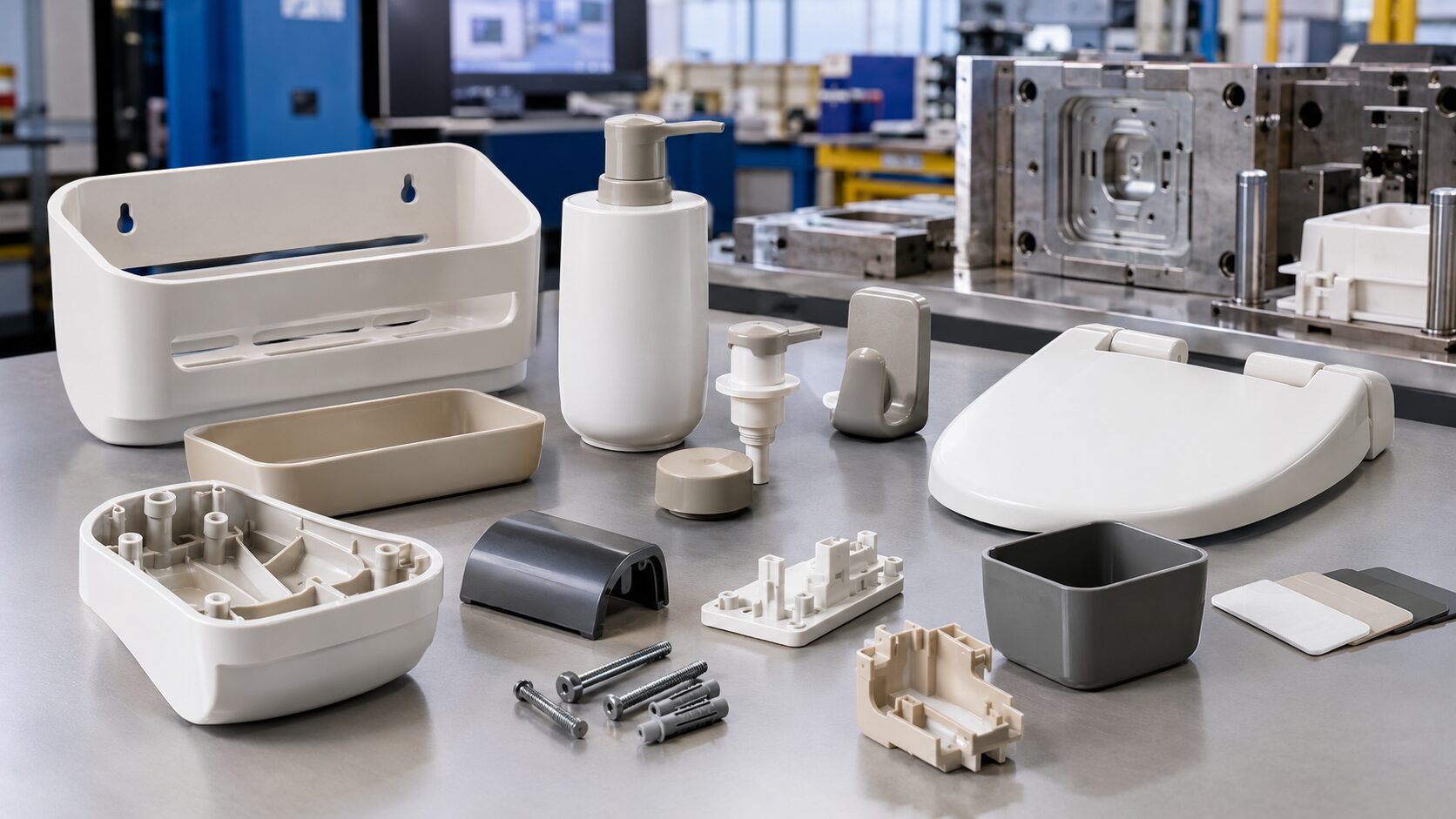
A shower caddy that cracks at the screw boss, a soap dispenser cap that leaks, or a toilet-seat hinge cover that loses its color can turn a simple plastic component into a warranty issue. This bathroom accessory molding guide is built for OEMs, product developers, and procurement teams that need to move from an attractive concept to a repeatable, production-ready part.
Bathroom accessories operate in a demanding environment. They face moisture, cleaners, temperature swings, frequent handling, and visible-surface expectations. Successful production depends on more than choosing a material or finding press capacity. It requires a coordinated decision on part design, resin, tool construction, molding parameters, finishing, and quality control before the first production run begins.
Start With the Part’s Real Operating Conditions
Bathroom products are often treated as low-complexity consumer components. In practice, the application determines nearly every manufacturing choice. A decorative towel hook and a concealed flush-button carrier may both be injection molded, but their functional requirements are entirely different.
Begin by defining where the part sits, how it is loaded, and what contacts it. Wall-mounted components need secure screw-boss geometry and resistance to long-term creep. Pump housings, drain components, and dispenser closures need controlled sealing surfaces and chemical compatibility. Handles, knobs, and grab-related accessories need stiffness, impact resistance, and a finish that remains acceptable after repeated cleaning.
The expected sales channel also matters. A hospitality product may require high replacement-volume consistency. A premium residential range may prioritize surface quality, metallic appearance, and tight assembly gaps. A value-engineered accessory may depend on achieving the right cycle time and resin cost without sacrificing basic durability. These are not downstream purchasing decisions. They should shape the part and tool design from the start.
Choose Materials for Moisture, Chemicals, and Appearance
Plastic selection for bathroom accessories is a balance of performance, appearance, processability, and cost. There is no universal best resin. The correct choice depends on the part’s geometry and use case.
ABS remains common for housings, covers, and decorative components because it molds well and supports a high-quality appearance, including plated finishes. Its limitations are lower chemical resistance and lower long-term heat performance than some engineering materials. For a component exposed only to normal bathroom conditions, it may be a practical option. For frequent exposure to aggressive cleaning agents, the decision needs more scrutiny.
Polypropylene is valued for moisture resistance, chemical resistance, low density, and hinge performance. It is well suited to caps, containers, internal features, and functional parts where a softer feel or living hinge is useful. However, PP can be more challenging when a premium glossy appearance, paint adhesion, or very tight dimensional control is required.
Polycarbonate and PC/ABS blends can provide higher impact strength and improved heat resistance for certain covers, dispensers, and control components. Nylon can be appropriate for mechanically loaded internal parts, although moisture absorption must be considered because it can affect dimensions and performance. Acetal is useful where low friction and dimensional stability are critical, such as certain moving mechanisms, but tool design and shrinkage control remain essential.
For visible parts, color matching should be validated with the selected resin grade, texture, and finishing method. White is particularly unforgiving: small variations in pigment, flow, gloss, or weld lines can become immediately visible. If the part will be chrome plated, painted, metallized, or overmolded with a soft-touch material, design and resin decisions must support that process rather than treating finishing as an afterthought.
Bathroom Accessory Molding Guide to Part Design
Good injection molding begins with geometry that can fill, pack, cool, release, and assemble consistently. A design that looks straightforward in CAD can create avoidable defects if wall thickness, draft, ribs, and joining features are not engineered for the process.
Maintain as uniform a wall thickness as the function allows. Thick sections cool slowly and are more likely to create sink marks, voids, and extended cycle times. If localized strength is needed, ribs and gussets are usually more effective than simply adding material. As a general approach, rib thickness should be controlled relative to the nominal wall to reduce visible sinks on cosmetic surfaces.
Draft is equally important. Textured exterior surfaces, deep cavities, and polished parts need sufficient draft to release without scuffing or stressing the component. The required angle depends on material, surface texture, and part depth, so it should be confirmed during design-for-manufacturing review rather than applied as a generic rule.
Screw bosses deserve special attention in bathroom products because many accessories are wall-mounted or repeatedly assembled. A boss that is too thick can sink or crack. One that is too thin may split under installation torque. Proper core design, gusseting, material selection, and fastener specification work together to create reliable retention. Where waterproofing is needed, sealing surfaces and gasket compression must be designed as controlled functional features, not improvised during assembly.
Tooling Decisions That Control Repeatability
The mold is the production system behind the part. Tooling quality affects dimensions, surface finish, cycle time, maintenance requirements, and the consistency of every future production run.
Gate location should be selected around flow behavior and appearance requirements. A poorly placed gate can create weld lines across a visible cover, distort a flat face, or leave a gate vestige in a customer-facing area. Mold-flow analysis and practical tooling experience help identify these risks before steel is cut.
Cooling deserves the same attention as cavity shape. Efficient, balanced cooling improves cycle time and helps control warpage, particularly on broad covers, trays, and asymmetrical housings. Parts with deep ribs, varying wall thicknesses, or tight flatness requirements may require more sophisticated cooling design. Saving cost on cooling can create a much larger cost in scrap, slow cycles, and corrective work later.
The number of cavities should match expected volume, product lifecycle, budget, and launch timing. A multi-cavity mold can lower piece cost at higher volumes, but it raises upfront tooling investment and requires careful cavity balancing. For a new product with uncertain demand, a single-cavity or limited-cavity tool may reduce commercial risk. For established programs, a production tool designed for sustained output is usually the better long-term decision.
Mold steel selection also depends on production expectations. Prototype tooling, bridge tooling, and high-volume tooling should not be treated as the same investment. Corrosion resistance, wear resistance, surface finish requirements, and planned maintenance all influence the appropriate steel and treatment choices.
Build Quality Controls Into the Production Plan
A visually acceptable molded part is not necessarily a conforming part. Bathroom accessories often involve assemblies, moving features, seals, plated surfaces, or installation interfaces that need repeatable verification.
Critical dimensions should be identified before production, especially mating features, snap fits, screw locations, seal lands, and cosmetic datum surfaces. A control plan can then define how those features are measured, how often they are checked, and what happens when a result moves outside tolerance. First-article inspection establishes the baseline, but ongoing process checks protect the program after approval.
Appearance standards should be documented with approved samples or clear defect criteria. Terms such as “good finish” are too subjective for production. Define acceptable and unacceptable levels for flow lines, gloss variation, black specks, gate marks, sink, flash, plating coverage, and color variation. This is especially valuable when production includes secondary operations such as painting, printing, ultrasonic welding, assembly, or packing.
Functional testing should reflect real use. That may include torque testing for assembled fasteners, leak testing for fluid-contact components, cycle testing for moving mechanisms, pull testing for clips, or chemical-exposure assessment for components likely to contact cleaners. The test plan should be proportionate to the application. Not every towel hook requires the same validation as a dispenser pump, but every product needs evidence that its key failure modes have been addressed.
Select a Manufacturing Partner With Full Process Control
Bathroom accessory programs move faster when the mold maker, molder, finisher, and quality team work from the same technical requirements. Splitting these stages across multiple suppliers can be workable, but it often slows design changes and makes accountability unclear when defects appear.
An integrated manufacturer can review the concept, refine the part for molding, fabricate and modify the tool, run trial parts, manage secondary processing, and prepare finished goods for shipment. That control is particularly valuable when a product needs fast iterations or when a discontinued component must be replicated with improved performance.
Ask practical questions before awarding a program: Can the supplier modify molds in-house? What press sizes are available for current and future demand? How are cosmetic standards controlled? Can the team support assembly and finishing? What is the process for correcting a dimensional issue after first trials? The answers reveal more than a quoted piece price.
Glasfil supports this type of end-to-end execution with in-house design, mold modification capability, injection molding capacity up to 560 tons, secondary processing, and quality assurance across two manufacturing plants. For OEM teams, that means fewer handoffs between concept, tool trial, production approval, and repeat supply.
The best time to solve a bathroom accessory manufacturing problem is before the tool is built. Bring the operating conditions, target volume, finish expectations, and assembly requirements into the first engineering review, and the finished part has a far better chance of performing well long after installation.
Contact us to discuss your project, request a quotation, or arrange a technical consultation. Our team will help you determine the most cost-effective and reliable way to manufacture your part.


