A water meter can fail long before its electronics, register, or measurement mechanism reaches its expected service life. Often, the limiting factor is a material decision made at the component level: a housing that absorbs too much moisture, a gear that wears under suspended solids, a seal that degrades in chlorinated water, or an insert that corrodes at the polymer-metal interface.
Selecting the best materials for water meter components requires more than comparing datasheets. Engineers and procurement teams need to balance potable-water requirements, pressure, temperature, water chemistry, dimensional stability, wear resistance, tooling cost, and production volume. The right answer depends on the meter type and operating environment, but a structured material strategy prevents expensive redesigns after validation or field deployment.
Start With the Meter Architecture
Material selection should follow the function of each part, not a single preference for plastic or metal. A residential mechanical meter, an ultrasonic meter, and an industrial remote-read meter place different demands on their housings, internal parts, and protective covers.
Mechanical meters include moving elements such as impellers, gears, spindles, bearings, and register interfaces. These parts need controlled friction, good wear behaviour, and dimensional repeatability. Ultrasonic meters eliminate many moving parts, but place more emphasis on housing geometry, sensor retention, acoustic performance, electronics protection, and long-term sealing.
The first question is whether a component is wetted, load-bearing, exposed to UV, in contact with potable water, or primarily cosmetic. A material that performs well for a dry external cover may be unsuitable for a precision wetted chamber.
Best Materials for Water Meter Components by Function
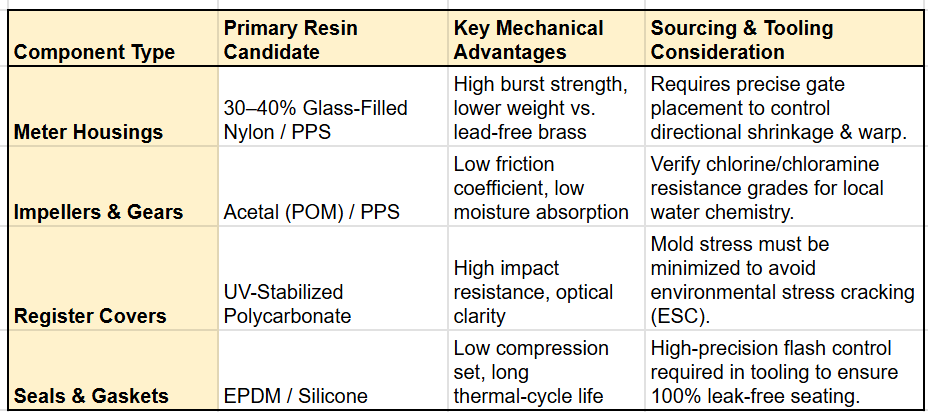
Meter bodies and wetted housings
Traditional meter bodies are commonly made from lead-free brass, bronze, ductile iron, or stainless steel. These materials remain appropriate where high pressure, threaded installation, impact resistance, and established utility specifications are the priority. They also provide familiar performance for large-diameter and commercial applications.
For many compact and residential designs, engineered plastics can reduce weight, simplify assembly, and remove corrosion concerns. Glass-filled nylon, polypropylene, polyphenylene sulfide (PPS), and certain reinforced thermoplastics are common candidates. The selection depends heavily on the water temperature and pressure rating.
Glass-filled nylon offers strength and stiffness, but it absorbs moisture. That absorption must be accounted for in dimensional tolerances, conditioning, and long-term performance. Polypropylene has excellent resistance to many water environments and low water absorption, but its lower stiffness and heat resistance may limit its use in high-pressure or high-temperature designs. PPS provides excellent dimensional stability, chemical resistance, and heat performance, although it carries a higher material and processing cost.
For a housing with precision sensor features or interfaces that must remain stable for years, PPS or a carefully engineered glass-filled nylon can be justified. For a lower-pressure cold-water body where cost and chemical resistance lead the decision, polypropylene may be the better production choice.
Impellers, gears, and moving internal components
Acetal, also known as POM, is frequently one of the strongest choices for low-friction internal water meter components. It offers low moisture absorption, good dimensional stability, low friction, and reliable wear performance. These properties make it well suited to gears, impellers, bearing elements, and moving register parts.
POM is not automatically the answer. Water treatment chemistry, especially chlorine exposure, can affect long-term performance depending on grade and operating conditions. Designers should specify a grade suitable for the intended potable-water environment and validate it through accelerated ageing and real-use testing.
PPS can be a stronger option when temperature, chemical exposure, or stiffness exceeds POM’s practical range. It is especially useful in technical meter assemblies where precision geometry and high-temperature resistance matter more than raw resin cost. In some cases, a combination works best: a PPS structural carrier with POM moving components where friction control is critical.
Transparent covers and register windows
A clear register window must retain visibility while resisting impact, cleaning agents, UV exposure, and moisture. Polycarbonate is widely used because of its impact strength and clarity. It can be a suitable option for protected register covers, but its chemical resistance must be checked against cleaners and service chemicals.
Acrylic provides excellent optical clarity and better scratch resistance than polycarbonate in some applications, but it is more brittle and less impact resistant. For outdoor installations, the decision should also include UV stabilisation, wall thickness, and whether the cover is likely to be struck during installation or maintenance.
Transparent parts are especially sensitive to moulding quality. Gate location, melt temperature, cooling balance, and internal stress can affect clarity and crack resistance. A clear material cannot compensate for poor process control.
Seals, gaskets, and diaphragm components
Elastomer selection deserves the same level of scrutiny as the rigid plastic or metal housing. EPDM is widely used for potable-water seals because it performs well with hot water, steam, and many chlorinated-water conditions. It is often a practical choice for gaskets, O-rings, and sealing interfaces.
Nitrile rubber, or NBR, has good resistance to oils but is generally less suitable than EPDM for hot water and ozone exposure. Silicone handles a wide temperature range and can be useful in specialised applications, though it may not offer the abrasion resistance or cost profile needed for every meter design.
Every seal material must be matched to compression set requirements, gland geometry, assembly method, water chemistry, and the required potable-water approvals. A seal that passes a short pressure test can still lose compression and create field leaks after years of thermal cycling.
Metal inserts, fasteners, and threaded interfaces
Plastic housings often need metal inserts for threaded connections, mounting points, or high-load joints. Brass is widely used for inserts because it machines well and supports reliable threading. However, alloy selection matters for potable-water contact and corrosion performance.
Stainless steel can offer stronger corrosion resistance, particularly for external fasteners and challenging water environments. The trade-off is cost, along with the need to control galvanic corrosion when multiple metals are present. Insert geometry, knurl design, moulding temperature, and post-moulding stress all influence whether an insert remains secure through pressure cycling.
Water Chemistry Changes the Decision
A material selection that works in one municipal system may not perform the same way in another. Chlorine or chloramine disinfectants, dissolved minerals, pH, sediment, water temperature, and stagnation periods all affect ageing.
Chlorinated water can accelerate degradation in some polymers and elastomers. Hard water may create deposits that increase friction in moving assemblies. Sediment can turn a low-friction bearing surface into a wear point. For meters installed outdoors or in pits, moisture, freeze-thaw cycles, UV exposure, and mechanical impact become equally relevant.
This is why material specifications should describe the service environment rather than simply naming a resin family. Specify temperature range, maximum pressure, expected disinfectant exposure, UV requirement, potable-water certification needs, and target service life. A complete specification gives the moulding and engineering team a basis for selecting the correct grade, reinforcement, colour concentrate, and stabiliser package.
Design for Injection Moulding, Not Just Material Performance
The best resin on paper can become a poor production decision if part geometry does not support stable moulding. Uneven wall thickness, sharp transitions, deep ribs, inadequate draft, or poorly positioned gates can cause warpage, sink, stress, and dimensional variation.
Glass-filled materials require particular attention. They offer stiffness and strength, but fibre orientation can create directional shrinkage. That affects roundness, flatness, sealing surfaces, and precision features. Tool design, gate placement, flow path, and cooling layout must be developed around the functional requirements of the part.
For components with tight interfaces, mould flow analysis and prototype validation can reduce risk before production tooling is finalised. This is especially valuable for meter covers, valve interfaces, sensor housings, and assemblies with overmolded or heat-staked inserts.
Glasfil supports this process with in-house mould design, fabrication, modification, injection moulding, and quality control, helping product teams move from component concept to repeatable production without splitting responsibility across multiple suppliers.
Validate Materials Under Real Operating Conditions
Data sheets are a starting point, not a field-life guarantee. Before final approval, test the material in conditions that reflect the actual meter application. Pressure cycling, thermal cycling, chemical ageing, UV exposure, drop or impact testing, torque testing, leak testing, and wear testing should be connected to the failure modes that matter for the design.
For moving components, measure changes in torque, rotational accuracy, wear debris, and dimensional fit after testing. For housings and seals, inspect for leakage, creep, cracking, discolouration, and loss of mechanical strength. For transparent covers, test optical clarity and stress cracking after exposure to relevant chemicals.
A practical validation plan also considers manufacturing variation. Test parts from early tool trials and production-representative runs, not only hand-finished prototypes. This reveals whether the material and process can consistently meet requirements at volume.
Make the Material Choice a Lifecycle Decision
The lowest resin price rarely represents the lowest component cost. A less expensive material may require thicker walls, longer cycle times, more complex assembly, tighter process control, or earlier replacement. A higher-performance material may reduce scrap, eliminate corrosion-related issues, improve dimensional consistency, and support a longer service interval.
For most water meter programs, the strongest result comes from assigning materials by function: corrosion-resistant structural materials for housings, low-friction polymers for moving mechanisms, durable elastomers for sealing, and carefully selected metals where threads or load-bearing interfaces require them. The next productive step is to define the actual operating conditions and test the proposed material stack as a complete assembly before the production tool locks in the decision.
Stop Guessing Resin Performance — Validate Your Meter Design Before Cutting Steel
Whether you are transitioning from lead-free brass to high-performance polymers or scaling up production for a smart ultrasonic meter program, material selection directly drives your Total Landed Cost and field warranty risk. Contact us now.